

Introduction
Managing money in healthcare is never simple. Between insurance verifications, claim submissions, and patient payments, hospitals and clinics deal with a complex web of financial transactions every single day. At the center of it all is the healthcare accounts receivable process — the structured system that ensures providers actually get paid for the care they deliver.
Healthcare accounts receivable (AR) refers to all the outstanding payments owed to a medical practice or healthcare organization after services have been rendered. These balances come from insurance companies, government payers like Medicare and Medicaid, and patients themselves. Without a well-managed AR process, even a thriving medical practice can face serious cash flow problems.
This step-by-step guide breaks down the complete accounts receivable process in healthcare — from patient registration to payment posting — so billing teams, practice managers, and administrators can optimize collections, reduce denials, and strengthen their overall financial performance.
What Is Healthcare Accounts Receivable?
Healthcare accounts receivable is the total amount of money owed to a healthcare provider for services already delivered but not yet paid. It sits on the balance sheet as an asset and represents the financial backbone of most medical organizations.
Unlike other industries, healthcare AR is uniquely complicated. Payments come from multiple sources — primary insurers, secondary insurers, and patients — each with their own rules, timelines, and claim requirements. A single patient visit can trigger a billing chain that lasts weeks or even months.
Key AR metrics every practice should track:
- Days in AR: The average number of days it takes to collect payment after a service date. Industry benchmark: under 40 days.
- AR Aging: How long outstanding balances have been unpaid (0–30, 31–60, 61–90, 90+ days).
- Clean Claim Rate: Percentage of claims accepted on first submission. Target: above 95%.
- Denial Rate: Percentage of claims rejected by payers. Industry average: 5–10%.
- Collection Rate: Percentage of the total amount billed that is actually collected.
Tracking these KPIs is the first step toward effective healthcare accounts receivable management.
The Accounts Receivable Process in Healthcare: Step-by-Step
Step 1: Patient Registration and Insurance Verification
The AR process begins before the patient even sees a doctor. Accurate patient registration is the foundation of clean billing.
During registration, front-desk staff collect:
- Full legal name and date of birth
- Primary and secondary insurance information
- Policy numbers and group IDs
- Referring physician details (if applicable)
- Contact and demographic information
After registration, the billing team performs insurance eligibility verification — confirming that the patient’s coverage is active, the provider is in-network, and the specific services are covered under the patient’s plan.
Why this step matters: Errors at registration — a misspelled name, wrong policy number, or expired insurance — are among the top causes of claim denials. Getting it right here prevents costly rework downstream.
Best practices for this step include verifying eligibility at least 48–72 hours before the appointment and using automated eligibility tools that connect directly to payer databases.
Step 2: Patient Check-In and Financial Counseling
On the day of the appointment, front-desk staff confirm registration details and collect any upfront patient financial responsibilities, such as:
- Copayments
- Outstanding balances from previous visits
- Deductible payments (if the deductible has not been met)
This is also when financial counseling should take place. For patients facing high-cost procedures, a financial counselor explains estimated out-of-pocket costs, available payment plans, and financial assistance options. Collecting copays and partial payments at the point of service dramatically reduces the patient AR balance that billing teams must chase later.
Step 3: Medical Coding
Once the patient is seen, the provider documents the encounter in the patient’s medical record. The coding team — or the provider, in smaller practices — translates that clinical documentation into standardized codes:
- ICD-10-CM codes — Diagnoses (e.g., Z00.00 for a routine adult health exam)
- CPT codes — Procedures and services (e.g., 99213 for a standard office visit)
- HCPCS Level II codes — Durable medical equipment, drugs, and supplies
Accurate coding is critical to the accounts receivable process in healthcare. Upcoding, undercoding, or mismatched diagnosis-procedure codes lead to claim denials, compliance risks, and delayed payments.
Common coding errors that trigger denials:
- Diagnosis code does not support the procedure billed
- Missing or incorrect modifiers
- Unbundling codes that should be billed together
- Services billed outside the scope of the provider’s specialty
Coding audits — both internal and external — are an essential part of healthcare accounts receivable management.
Step 4: Charge Entry and Claim Creation
After coding, the billing team enters charges into the practice management system. Charge entry involves:
- Assigning the correct fee schedule amounts
- Linking diagnosis codes to procedure codes
- Adding provider, facility, and date-of-service information
- Selecting the correct payer and plan
Once charges are entered, the system generates a claim — typically in CMS-1500 format for professional billing or UB-04 format for facility billing. The claim bundles all the coded and demographic information into a structured file that payers can process.
Before submission, claims go through a scrubbing process. The billing software checks for errors like missing fields, invalid codes, and formatting issues. Catching these problems at the scrubbing stage — rather than after rejection — is key to maintaining a high clean claim rate in accounts receivable medical billing.
Step 5: Claim Submission to Payers
With the claim scrubbed and approved, the billing team submits it to the appropriate payer. Claims are submitted in two ways:
- Electronically (EDI): The fastest and most common method. Electronic claims are transmitted via a clearinghouse that routes them to the correct payer and returns acknowledgment reports within 24–48 hours.
- Paper claims: Used in rare cases where a payer does not accept electronic submission. Paper claims slow the entire process and should be avoided when possible.
Clearinghouse role in AR: A clearinghouse acts as an intermediary between the provider and the payer. It validates claims, translates them into payer-specific formats, and routes them to hundreds of different insurance companies. Using a robust clearinghouse reduces rejection rates significantly.
Timely filing deadlines vary by payer. Medicare typically requires claims within 12 months of the service date; commercial payers may impose 90-day or 180-day windows. Missing a filing deadline means the claim is denied with no right to appeal — a preventable revenue loss that directly impacts the healthcare revenue cycle.
Step 6: Payment Posting
Once the payer processes the claim, they issue an Explanation of Benefits (EOB) or, for electronic payments, an Electronic Remittance Advice (ERA). These documents detail:
- How much was billed
- How much was allowed under the contracted rate
- How much the payer is paying
- What adjustments were made (e.g., contractual discounts)
- What patient responsibility remains
The billing team then posts these payments to the patient accounts in the practice management system. Accurate payment posting is essential because it:
- Reflects true account balances
- Triggers any secondary billing (when a patient has two insurance plans)
- Identifies underpayments from payers
- Determines what the patient owes after insurance
Secondary billing: If the patient has secondary insurance, the billing team submits a crossover claim (or a manually prepared secondary claim) with the primary EOB attached, so the secondary payer knows what has already been paid.
Step 7: Denial Management
Denials are a fact of life in accounts receivable management in medical billing. No matter how efficient the billing team, some claims will be rejected or denied. The difference between high-performing and struggling practices is how quickly and effectively they respond.
Common denial reasons:
- CO-4: Incorrect procedure/modifier combination
- CO-11: Diagnosis inconsistent with the procedure
- CO-27/CO-29: Timely filing expired
- CO-97: Service included in another payment
- PR-1 / PR-2: Patient deductible or coinsurance responsibility
- CO-4 / CO-22: Service not covered by the plan
The denial management workflow:
- Identify the denial reason from the EOB or ERA
- Determine if the denial is correctable (coding error, missing documentation) or non-correctable (timely filing lapse)
- Correct the claim if errors exist
- File a reconsideration or formal appeal with supporting documentation
- Track the appeal through to resolution
- Document the denial pattern to prevent recurrence
Strong denial management is the single biggest lever in improving revenue cycle management in healthcare. Reducing denials by even a few percentage points can translate to tens of thousands of dollars in recovered revenue.
Step 8: Accounts Receivable Follow-Up
Claims that are neither paid nor denied within a reasonable timeframe — typically 30 to 45 days — require active follow-up. This is one of the most labor-intensive parts of the accounts receivable process in healthcare, but also one of the most impactful.
AR follow-up involves:
- Running aging reports to identify unpaid claims
- Contacting payers by phone or portal to check claim status
- Resubmitting lost or unprocessed claims
- Escalating high-dollar underpayments to a supervisor or payer representative
- Appealing downcoded or bundled claims
Many billing departments segment AR follow-up by payer type (Medicare, Medicaid, commercial, self-pay) and by dollar amount — prioritizing high-dollar claims first to maximize revenue recovery per hour worked.
Automation in AR follow-up: Modern revenue cycle management platforms use automated worklists that prioritize claims based on aging, value, and payer response patterns. This ensures follow-up staff spend time on accounts most likely to yield payment, rather than working through AR randomly.
Step 9: Patient Billing and Collections
After insurance has paid its portion, any remaining balance becomes the patient’s responsibility. The patient billing process includes:
- Generating and mailing a clear, itemized patient statement
- Offering online payment options (patient portal, payment link)
- Providing payment plan options for larger balances
- Sending reminder notices at 30, 60, and 90 days
- Making courtesy collection calls for balances over a set threshold
Patient AR is the fastest-growing segment of healthcare receivables, driven by the rise of high-deductible health plans (HDHPs). In many practices, patients now account for 20–30% of total revenue — making patient collections a priority within healthcare accounts receivable management.
Best practices for patient collections:
- Send statements within 5–7 days of insurance adjudication
- Make it easy to pay online or by phone
- Train staff on empathetic, non-confrontational collection conversations
- Offer financial assistance or charity care for eligible patients
- Use a third-party collection agency only as a last resort (90+ days, exhausted internal efforts)
Step 10: Reporting and Performance Analysis
The final step in the AR cycle is ongoing measurement and improvement. The billing team and practice leadership should review key AR metrics monthly — or more frequently in larger organizations.
Essential AR reports:
- AR Aging Report: Breaks down outstanding balances by age bucket (0–30, 31–60, 61–90, 90+ days). A healthy AR has the majority of balances in the 0–30 day bucket.
- Denial Rate Report: Tracks denial volumes and root causes by payer and code.
- Clean Claim Rate Report: Measures first-pass acceptance rates.
- Days in AR Report: Tracks the trend in average collection timeline.
- Payer Mix Report: Analyzes revenue by payer to identify high-denial or slow-paying insurers.
Regular reporting transforms AR management from a reactive process into a strategic one. Practices that consistently review and act on AR data see measurably better financial performance than those that do not.
Why Healthcare Revenue Cycle Management Matters
The AR process does not exist in isolation. It is part of a broader framework called the healthcare revenue cycle — the end-to-end process from patient scheduling to final payment. Every step in the revenue cycle affects AR performance.
Revenue cycle management in healthcare encompasses:
- Patient access (scheduling, registration, eligibility)
- Clinical documentation and coding
- Charge capture and claim submission
- Payment posting and reconciliation
- Denial management and appeals
- Patient billing and collections
- Reporting and analytics
When all these components work together smoothly, the result is faster collections, fewer denials, reduced administrative costs, and stronger financial health for the organization. When any one step breaks down, the effects ripple through the entire AR cycle.
Technology’s role in RCM: Modern revenue cycle platforms — including electronic health records (EHRs) with integrated billing modules, AI-driven coding tools, and automated denial management systems — are dramatically improving AR performance across healthcare organizations of all sizes.
Common Challenges in Accounts Receivable Medical Billing
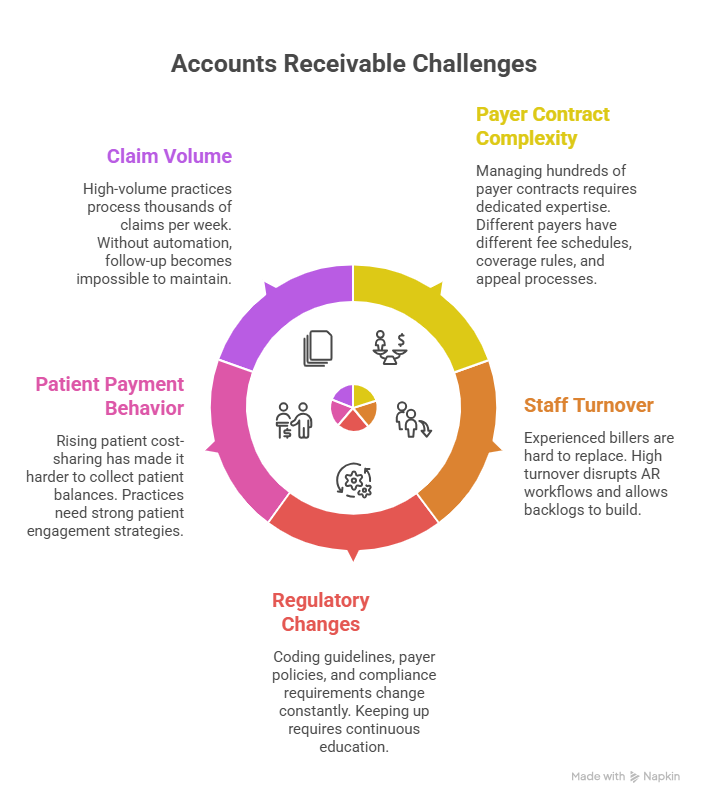
Even well-run billing departments face ongoing challenges:
- Payer contract complexity: Different payers have different fee schedules, coverage rules, and appeal processes. Managing hundreds of payer contracts requires dedicated expertise.
- Staff turnover: Experienced billers are hard to replace. High turnover disrupts AR workflows and allows backlogs to build.
- Regulatory changes: Coding guidelines, payer policies, and compliance requirements change constantly. Keeping up requires continuous education.
- Patient payment behavior: Rising patient cost-sharing has made it harder to collect patient balances. Practices need strong patient engagement strategies.
- Claim volume: High-volume practices process thousands of claims per week. Without automation, follow-up becomes impossible to maintain.
Outsourcing accounts receivable management in medical billing to a specialized RCM company is a common solution for practices that lack internal capacity or expertise. A strong outsourced billing partner brings technology, trained staff, and payer relationships that most practices cannot build on their own.
Conclusion
The healthcare accounts receivable process is one of the most complex — and most important — financial workflows in any medical organization. From patient registration to final payment, each step in the process requires precision, coordination, and consistent follow-through.
Practices that invest in strong accounts receivable management in medical billing — through trained staff, modern technology, and continuous performance measurement — collect more revenue, reduce denials, and serve their patients better. Whether you manage AR in-house or partner with an outsourced RCM provider, understanding each step of the process is the foundation of financial success in healthcare.
Start by auditing your current AR performance against industry benchmarks. Identify your biggest denial categories, check your Days in AR trend, and look for gaps in your follow-up workflows. Small, consistent improvements in your healthcare revenue cycle process compound over time — and the financial results speak for themselves.
Frequently Asked Questions
What is accounts receivable in healthcare?
Accounts receivable in healthcare refers to the outstanding payments owed to a healthcare provider for services already delivered. These balances are owed by insurance companies, government payers (Medicare, Medicaid), and patients. Managing healthcare AR effectively is critical to maintaining healthy cash flow.
What is a good Days in AR benchmark for medical practices?
Most healthcare organizations aim to keep Days in AR below 40 days. High-performing practices often achieve 30–35 days. Anything above 50 days is a warning sign that the AR process needs attention.
What causes high AR days in medical billing?
High AR days are typically caused by a combination of factors: high denial rates, slow payer processing, inadequate follow-up, poor coding accuracy, and delayed claim submission. Addressing these root causes through systematic process improvement is the path to better AR performance.
How does revenue cycle management differ from accounts receivable management?
Revenue cycle management (RCM) is the broader, end-to-end process from patient scheduling through final payment. Accounts receivable management is a subset of RCM focused specifically on tracking and collecting outstanding balances after services are billed. Strong AR management is essential to a healthy healthcare revenue cycle.
What is the difference between a denial and a rejection in medical billing?
A rejection occurs before the claim enters the payer’s adjudication system — it means the claim has a formatting error or missing field that prevents processing. A denial occurs after the payer reviews the claim and determines not to pay it, citing a specific reason code. Rejections are corrected and resubmitted; denials may require appeals.