

Medical Billing Services: Complete Guide for Providers
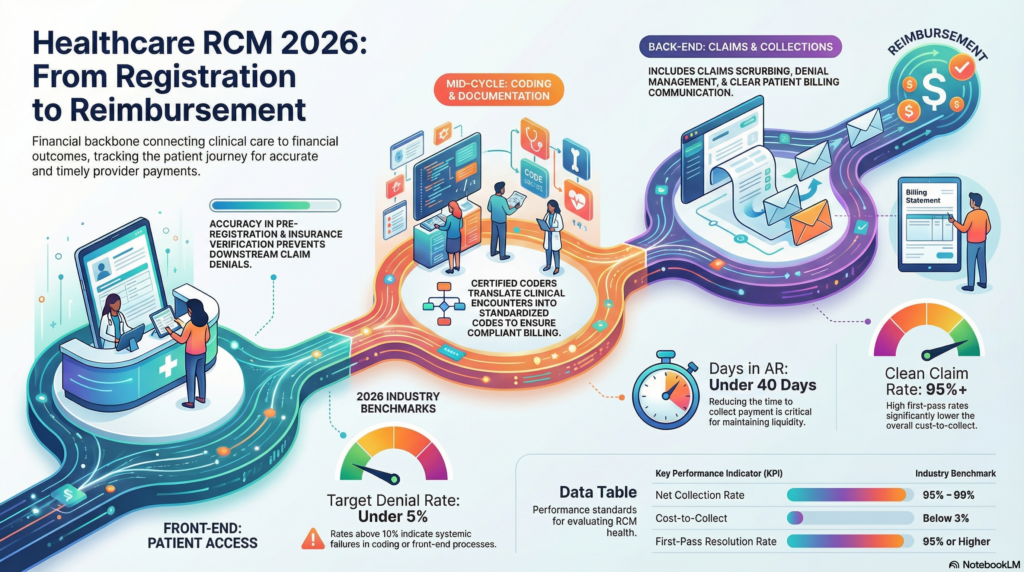
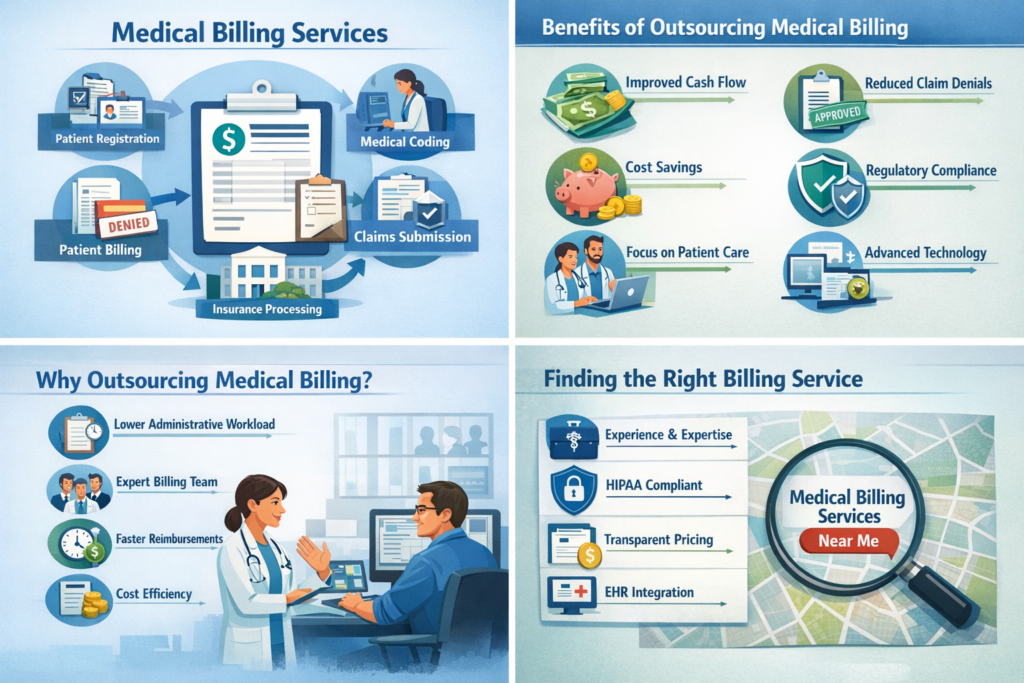
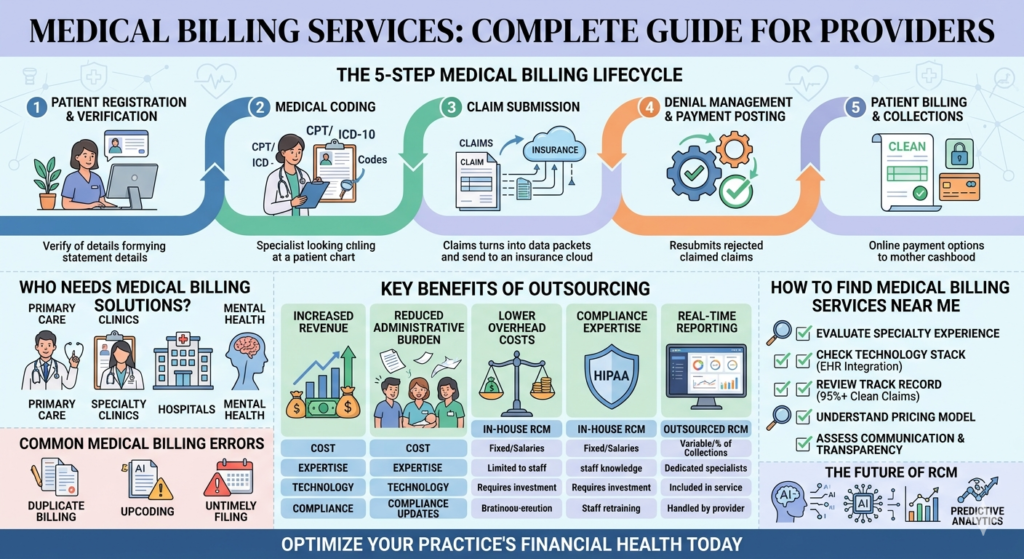
Introduction Running a successful healthcare practice means more than delivering excellent patient care — it also means getting paid accurately and on time. Medical billing services have become essential for providers who want to reduce claim denials, speed up reimbursements, and eliminate the administrative burden that drains staff time and energy. Whether you are a solo practitioner, a specialty clinic, or a multi-location healthcare group, understanding how professional medical billing works can transform your practice’s financial health. This complete guide walks you through everything you need to know — from the basics of medical billing to finding trusted medical billing services near me and implementing a robust revenue cycle management strategy. What Are Medical Billing Services? Medical billing services are specialized solutions that handle the process of submitting, tracking, and collecting payments for healthcare services rendered by providers. Instead of managing in-house billing staff, many practices outsource this function to dedicated billing companies or use advanced billing software platforms. These services cover the full lifecycle of a claim — from patient registration and insurance verification to claim submission, denial management, and final payment posting. Who Needs Medical Billing Services? Medical billing solutions serve a wide range of healthcare providers, including: Regardless of size or specialty, any provider that accepts insurance or processes patient payments can benefit from professional billing support. How Does the Medical Billing Process Work? Understanding the step-by-step flow of medical billing helps providers appreciate the complexity involved and the value that expert billing teams bring to the table. Step 1: Patient Registration and Insurance Verification Before a patient is seen, billing teams verify insurance eligibility and coverage details. This prevents claim rejections caused by inactive policies or inaccurate demographic information. Step 2: Medical Coding Clinical documentation from the visit is translated into standardized codes — ICD-10 diagnosis codes and CPT procedure codes. Accurate coding is critical. Even minor coding errors can trigger denials or compliance audits. Step 3: Claim Submission Clean claims are submitted electronically to insurance payers. Timely submission is essential, as most payers enforce filing deadlines that, if missed, result in permanent non-payment. Step 4: Payment Posting and Denial Management Once payers process claims, payments are posted to patient accounts. When claims are denied, billing specialists review the reason, correct any errors, and resubmit. This appeals process is where expert billing teams truly demonstrate their value. Step 5: Patient Billing and Collections After insurance pays its portion, any remaining balance is billed to the patient. Professional billing services handle this diplomatically, protecting patient relationships while ensuring collections. Key Benefits of Outsourcing Medical Billing Solutions Outsourcing medical billing solutions offers measurable advantages over relying entirely on in-house staff. Here is why thousands of providers are making the switch. 1. Increased Revenue and Faster Reimbursements Professional billing teams know how to submit cleaner claims the first time, reducing the denial rate significantly. Faster approvals mean money reaches your practice sooner — improving cash flow and financial stability. 2. Reduced Administrative Burden Billing is time-consuming. When your front desk and clinical staff are focused on billing tasks, patient care suffers. Outsourcing frees your team to concentrate on what they do best — caring for patients. 3. Lower Overhead Costs Hiring, training, and retaining in-house billing staff is expensive. Add the cost of billing software, compliance training, and employee benefits, and the numbers add up quickly. Medical billing services typically charge a percentage of collections — meaning you only pay when you get paid. 4. Compliance and Regulatory Expertise Healthcare billing regulations change constantly. HIPAA requirements, payer-specific rules, and coding guideline updates demand ongoing education. Professional billing companies stay current so your practice remains compliant and audit-ready. 5. Access to Real-Time Reporting Most modern medical billing services provide dashboards and reports that show your practice’s financial health at a glance — from days in accounts receivable to denial rates and collection performance. Understanding Revenue Cycle Management in Medical Billing Revenue cycle management in medical billing (RCM) refers to the end-to-end process of managing the financial interactions between a patient and a healthcare provider. It begins at the moment a patient schedules an appointment and ends when every dollar owed has been collected. Medical revenue cycle management is broader than billing alone. It encompasses: Why Revenue Cycle Management Matters A fragmented revenue cycle is one of the top reasons healthcare practices lose money without realizing it. Studies consistently show that 5–10% of medical claims are denied on the first submission, and many of those denials are never reworked — leaving significant revenue uncollected. Effective medical revenue cycle management closes those gaps. By identifying bottlenecks, correcting front-end errors, and aggressively managing denials, RCM specialists help practices recover revenue that would otherwise be written off. In-House RCM vs. Outsourced RCM Factor In-House RCM Outsourced RCM Cost Fixed (salaries, training, software) Variable (% of collections) Expertise Limited to staff knowledge Dedicated specialists Scalability Difficult to scale quickly Easily scalable Technology Requires investment Included in service Compliance updates Staff must be retrained Handled by provider For most small to mid-sized practices, outsourced medical revenue cycle management delivers a stronger return on investment. How to Find Medical Billing Services Near Me Searching for medical billing services near me can feel overwhelming given the number of providers in the market. Here is a practical framework to evaluate your options and choose the right partner. 1. Evaluate Their Specialty Experience Not all billing companies handle all specialties equally. A billing firm experienced in mental health coding may not have deep expertise in surgical specialties. Always ask for references from providers in your specific specialty. 2. Check Their Technology Stack Modern billing services should integrate seamlessly with your electronic health record (EHR) system. Ask about their practice management software, clearinghouse partnerships, and real-time reporting capabilities. 3. Review Their Track Record Ask potential billing partners about their: 4. Understand Their Pricing Model Most billing companies charge between 4–9% of monthly collections, depending on specialty and volume. Be cautious of flat-fee models that do not incentivize strong collection performance.