
CareVantaRCM

Optimize Revenue. Reduce Denials. Strengthen Practice Growth.

Blog

Your blog category

revenue cycle management
Healthcare Accounts Receivable

Healthcare Accounts Receivable Process Guide

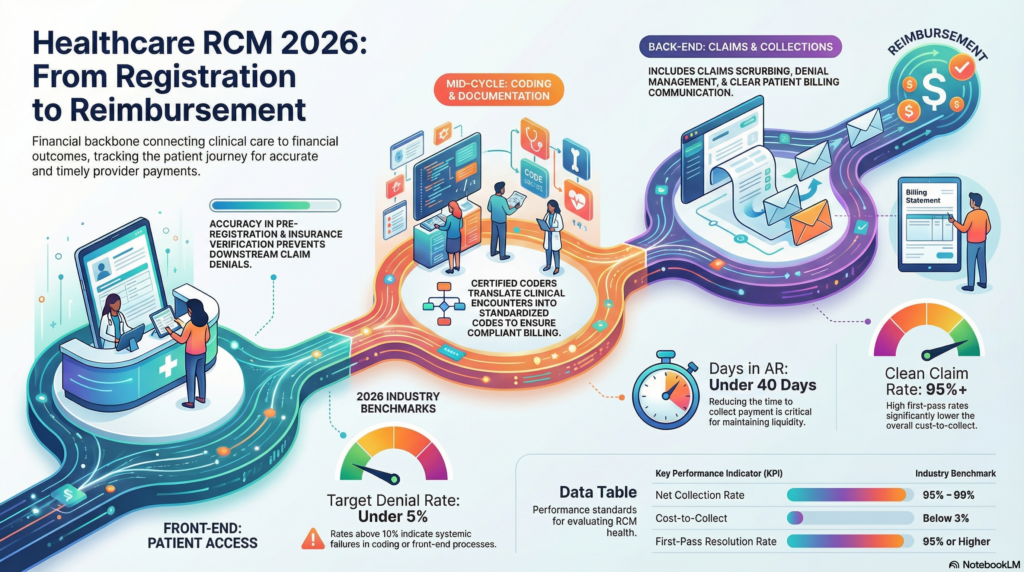
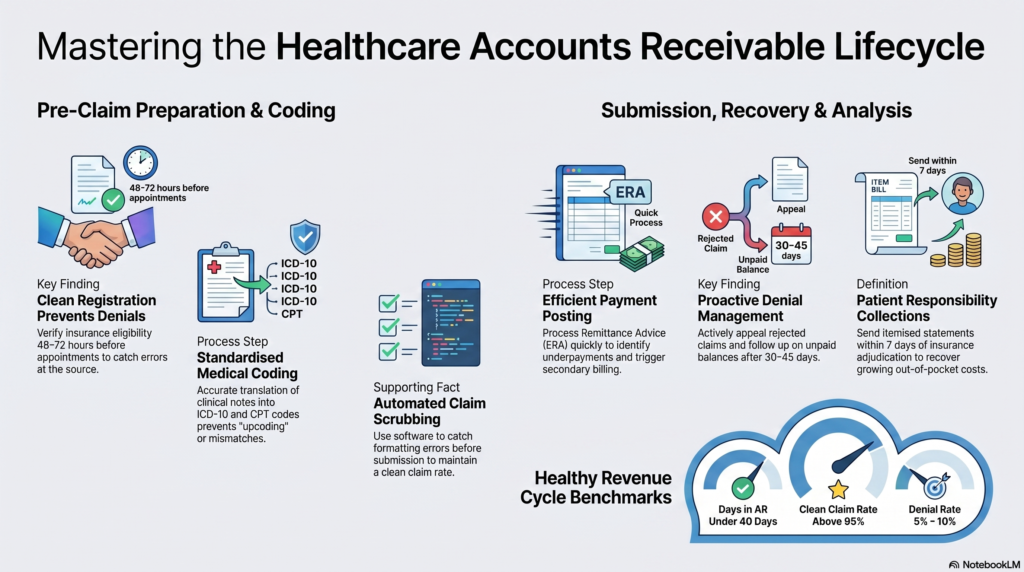
Introduction Every dollar a healthcare provider earns starts as a claim — and far too many of those claims never get paid on time. In fact, the American Medical Association reports that nearly 1 in 5 claims is initially denied or delayed, costing practices millions in lost or deferred revenue each year. That’s where healthcare accounts receivable management becomes mission-critical. Whether you run a small independent clinic or a large hospital system, understanding the full accounts receivable process in healthcare is the difference between a practice that thrives and one that constantly struggles with cash flow gaps. This guide breaks down everything — from the step-by-step AR workflow to the best medical accounts receivable solutions available today. You’ll walk away knowing exactly how to tighten your revenue cycle, reduce claim denials, and get paid faster for every service you deliver. What Is Healthcare Accounts Receivable? Healthcare accounts receivable refers to the money owed to a healthcare provider for services that have already been delivered but not yet paid. When a physician sees a patient, submits a claim, and waits for reimbursement from an insurance company or patient, that outstanding balance lives in the AR ledger until it’s collected. Think of AR as a running tab of earned revenue that hasn’t landed in your bank account yet. In most healthcare practices, AR balances come from three primary sources: Managing these balances efficiently is the core goal of healthcare accounts receivable management. A well-run AR process keeps aging balances low, denial rates minimal, and collection timelines as short as possible. Without a structured AR process, even high-volume practices can find themselves in a cash flow crisis — delivering care but waiting months (or never) to be reimbursed. The Accounts Receivable Process in Healthcare — Step by Step The accounts receivable process in healthcare is not a single event. It’s a multi-stage workflow that begins before the patient ever walks through the door and continues until every dollar owed is collected or written off. Here’s how it works: Step 1: Patient Registration and Insurance Verification Accurate AR management starts at the front desk. Collecting correct demographic information — name, date of birth, insurance ID, and group number — prevents costly errors downstream. Before the appointment, staff should verify: Failing to verify eligibility is one of the most common reasons claims get denied. This single step, when done correctly, eliminates a large percentage of preventable rejections. Step 2: Charge Capture After the patient is seen, the clinical encounter must be translated into billable charges. Physicians and clinical staff document services using: Accurate charge capture is essential. Under-coding leaves money on the table. Over-coding triggers audits and penalties. Clean, precise coding is the foundation of a strong accounts receivable medical billing workflow. Step 3: Claims Submission Once charges are captured and reviewed, the billing team submits claims to the appropriate payers. Most practices use electronic claim submission through clearinghouses, which scrub claims for errors before they reach the insurer. Claims are submitted on: Timely filing is critical. Most payers have strict deadlines — often 90 days to 1 year from the date of service. Missing those windows means automatic denial with no appeal option. Step 4: Payment Posting When payments arrive from payers or patients, they must be accurately posted to the correct patient accounts. Payment posting includes: Precise payment posting keeps your AR ledger accurate and ensures that patient statements reflect the correct balance owed. Step 5: AR Follow-Up and Denial Management This is where the real work of account receivable process in medical billing happens. Any claim not paid within 30–45 days needs proactive follow-up. The AR follow-up team should: We’ll cover denial management in more detail in a later section. Step 6: Patient Collections After insurance has paid its portion, any remaining balance is billed to the patient. The collections process includes: With patient financial responsibility rising due to high-deductible health plans, this step is increasingly important to overall collection rates. Step 7: Reporting and Analysis The final step is measuring everything. Regular AR reporting reveals: These insights fuel continuous improvement across the entire AR cycle. Key Metrics That Drive Healthcare AR Performance To manage what you can’t measure, you need to track the right KPIs. Strong healthcare accounts receivable management relies on these core metrics: Days in Accounts Receivable (DAR) This measures the average number of days it takes to collect payment after a service is provided. The industry benchmark is under 40 days. Anything above 50 days indicates systemic billing problems. Formula: Total AR ÷ (Annual Charges ÷ 365) First-Pass Claim Acceptance Rate This is the percentage of claims accepted and paid on the first submission — without correction or resubmission. A healthy rate is 95% or higher. Low first-pass rates signal coding errors, eligibility failures, or missing documentation. Net Collection Rate This measures the percentage of collectible revenue actually collected. It removes contractual write-offs from the equation and focuses on avoidable losses. Formula: (Payments ÷ (Charges − Contractual Adjustments)) × 100 A net collection rate below 95% means money is leaking out of your practice through denials, write-offs, and uncollected balances. Denial Rate The percentage of submitted claims denied by payers. Industry benchmark is under 5%. High denial rates directly reduce cash flow and inflate AR aging balances. Aging AR Percentage Track what percentage of your AR sits in each aging bucket. Ideally: When balances pile up in the 90+ day bucket, collectability drops sharply — many insurers and patients become nearly impossible to collect from after 120 days. Healthcare Accounts Receivable Management Best Practices Effective healthcare accounts receivable management isn’t about working harder — it’s about building smarter processes. These best practices separate high-performing revenue cycles from struggling ones: Prioritize Front-End Accuracy Most AR problems are back-end symptoms of front-end mistakes. Investing in thorough eligibility verification, accurate registration, and upfront patient cost estimates reduces errors that create downstream denials. Implement Denial Tracking by Root Cause Don’t just work denials — analyze them. Categorize every denial by root

medical billing outsourcing
Medical billing outsourcing

Outsource Medical Billing Services: Key Benefits for Healthcare Practices

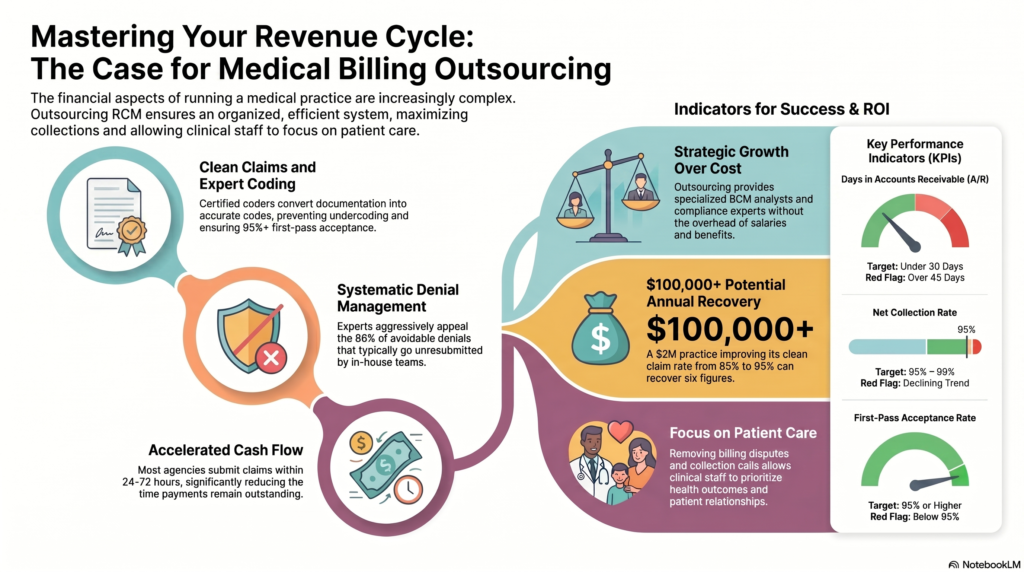
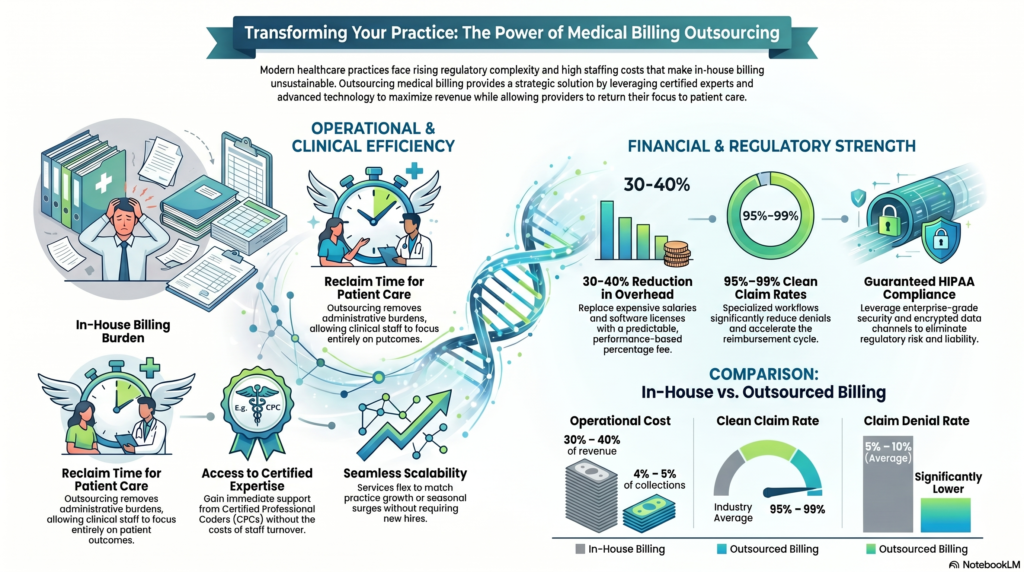
Introduction Running a healthcare practice today is more demanding than ever. Between delivering quality patient care, navigating ever-changing insurance regulations, and managing administrative operations, physicians and practice managers are stretched in multiple directions. One area that consistently drains time, money, and energy is medical billing. Medical billing outsourcing has emerged as one of the most powerful strategies for healthcare providers looking to streamline operations, increase revenue, and cut unnecessary costs. When you outsource medical billing services to a dedicated team of certified professionals, your practice gains access to specialized expertise, cutting-edge billing software, and a proven process designed to maximize reimbursements. This comprehensive guide explores everything you need to know about outsourcing medical billing — from the core benefits and how to select the right billing outsourcing services, to what the process looks like in practice and how it transforms your revenue cycle. Whether you are a solo practitioner or manage a multi-specialty group, understanding medical billing outsourcing can be the turning point that drives lasting financial and operational improvement. What Is Medical Billing Outsourcing? Medical billing outsourcing is the practice of hiring a third-party company or specialized service provider to handle all or part of your revenue cycle management (RCM) on your behalf. Rather than maintaining an in-house billing department, healthcare providers delegate billing responsibilities — including charge capture, claim submission, denial management, payment posting, and accounts receivable follow-up — to experienced outsource billing companies. These billing outsourcing services operate as an extension of your practice. They work closely with your clinical and administrative staff, integrate with your existing Electronic Health Record (EHR) systems, and follow strict protocols to ensure that every claim is submitted accurately and reimbursed promptly. Medical billing outsourcing companies range from large national RCM firms serving hospital systems to specialized boutique agencies that focus exclusively on specific medical specialties. Regardless of size, the best outsource billing companies share a commitment to coding accuracy, compliance, and performance-driven results. Outsourcing is not a one-size-fits-all solution, but it is a model that consistently delivers measurable improvements in clean claim rates, denial rates, days in accounts receivable, and net collection rates — making it an increasingly popular choice for practices of all sizes. The Growing Demand for Outsource Medical Billing Services The U.S. healthcare industry is undergoing rapid transformation. Regulatory complexity, the shift toward value-based care, evolving payer requirements, and staffing shortages have made in-house billing increasingly difficult to sustain at a high level. Billing errors cost the healthcare industry billions of dollars every year. Studies show that claim denial rates average between 5% and 10% across healthcare organizations, with some specialties experiencing even higher rates. Denied and delayed claims reduce cash flow, consume staff time, and, in worst-case scenarios, lead to revenue that is never recovered. Additionally, the ongoing challenge of finding, training, and retaining skilled billing staff has pushed more practices to consider outsourcing medical billing as a strategic alternative. High staff turnover in billing departments disrupts workflows, increases errors, and adds significant hidden costs in the form of recruitment and retraining expenses. These pressures have fueled strong growth in the medical billing outsourcing market. More practices, hospitals, and healthcare groups are recognizing that partnering with specialized outsource billing services offers a measurably better outcome than trying to manage this complex function internally — especially when core competencies lie in clinical care rather than billing administration. Key Benefits of Outsourcing Medical Billing Understanding the specific advantages is crucial before making any outsourcing decision. Here are the ten most impactful benefits of outsourcing medical billing that practices report after making the switch. 1. Significant Cost Reduction One of the most compelling benefits of outsourcing medical billing is the dramatic reduction in operational costs. Maintaining an in-house billing team involves salaries, benefits, paid time off, health insurance, ongoing training, billing software licenses, hardware, and office space. These costs add up quickly — often totaling 30% to 40% of total billing revenue for smaller practices. When you outsource billing services, you replace this complex cost structure with a predictable, performance-based fee — typically a percentage of collections (usually 4%–9%) or a flat monthly rate. This shift eliminates the overhead of managing employees entirely and ensures you only pay for results. The savings extend beyond payroll. Medical billing outsourcing companies invest in their own state-of-the-art billing platforms, clearinghouses, and compliance monitoring tools. You benefit from enterprise-grade infrastructure without incurring the capital expense to acquire it. For small and mid-sized practices in particular, this cost efficiency is transformational. Resources that were previously consumed by billing operations can be redirected toward patient care, equipment upgrades, or practice expansion. 2. Improved Revenue Cycle Management Revenue cycle management (RCM) is the financial backbone of any healthcare practice. It encompasses every step from patient registration and insurance verification through charge capture, coding, claim submission, payment posting, and collections. When any part of this cycle breaks down, revenue suffers. Medical billing outsourcing companies are specialists in RCM. Their teams understand every phase of the revenue cycle and apply proven, optimized workflows to accelerate cash flow and reduce revenue leakage. They conduct eligibility verifications before appointments, flag potential coding issues before claims are submitted, and aggressively follow up on outstanding balances. The result is a healthier revenue cycle with shorter accounts receivable (A/R) cycles, higher collection rates, and fewer write-offs. Practices that outsource medical billing services typically see a measurable improvement in their net collection rate — often moving from below-average collection rates to industry-leading performance within the first few months. 3. Fewer Claim Denials and Faster Reimbursements Claim denials are one of the biggest threats to a practice’s financial health. Each denied claim requires staff time to identify the reason, correct the error, and resubmit — a process that can take weeks. In many cases, denials that are not addressed promptly result in permanent revenue loss. Outsourcing medical billing significantly reduces denial rates by deploying certified medical coders and billing specialists who are trained to get claims right the first time. Medical billing outsourcing companies maintain

Best Medical Billing Services
Medical Billing Services

Best Medical Billing Services & RCM Solutions for Providers

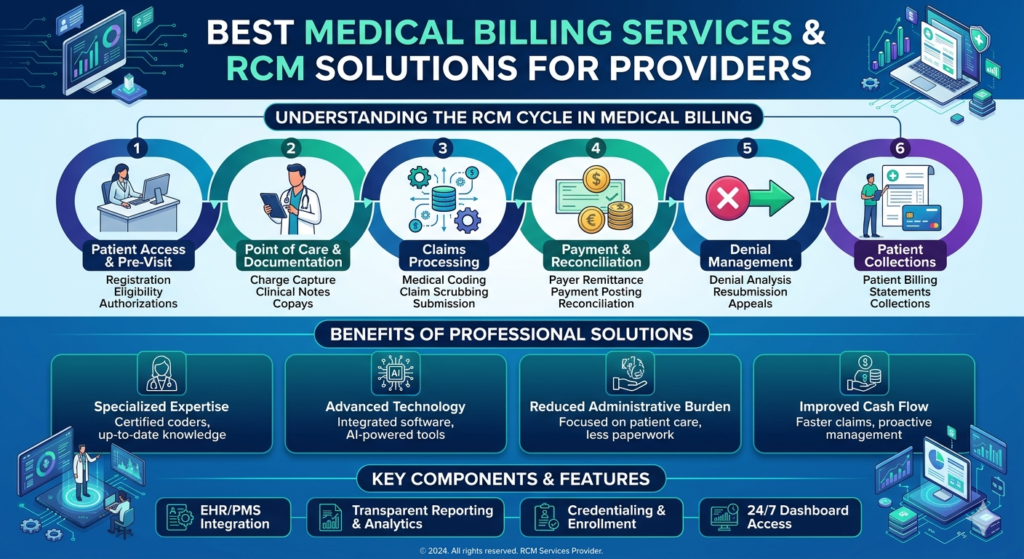
Introduction Running a successful healthcare practice today requires more than exceptional clinical care. Behind every patient visit is a complex financial process that determines whether your practice gets paid — accurately and on time. If your team is spending more time chasing unpaid claims than caring for patients, it’s time to explore the best medical billing services for healthcare providers available in the market. Medical billing is the backbone of any practice’s revenue stream. From charge capture to claim submission, denial management to patient collections, every step matters. A single error in a billing code can delay payment by weeks or result in a full denial. That’s why thousands of healthcare providers across the country are turning to professional medical billing services and comprehensive revenue cycle management in medical billing to streamline their operations. In this guide, we break down everything you need to know — from understanding what the RCM cycle in medical billing looks like to identifying the right medical billing solutions for your unique practice. Whether you’re a solo practitioner, a multi-specialty group, or a hospital system, this resource will help you make informed decisions that protect your revenue and grow your bottom line. What Are Medical Billing Services? Medical billing is the process of submitting and following up on claims with health insurance companies to receive payment for services rendered by a healthcare provider. It involves translating medical procedures and diagnoses into standardized codes that payers use to process and reimburse claims. Medical billing services are third-party companies or in-house teams that manage this entire process on behalf of healthcare providers. These services take on the responsibility of submitting accurate claims, handling rejections, and ensuring that providers receive maximum reimbursement for their services. The process involves multiple steps: When done professionally, medical billing ensures your practice maintains a healthy cash flow and reduces the risk of financial loss due to coding errors or missed deadlines. Why Healthcare Providers Need Professional Medical Billing Solutions Many small practices still rely on in-house billing teams or manual processes. While this may seem cost-effective, it often leads to significant revenue leakage. According to industry studies, healthcare providers lose between 5% and 11% of potential revenue due to billing errors, missed charges, and improper claim submission. Professional medical billing solutions address these gaps by providing: Specialized Expertise Medical billing specialists stay current with ever-changing payer rules, coding updates, and regulatory requirements. They understand the nuances of different insurance contracts, which means fewer errors and faster reimbursements. Advanced Technology Modern billing services use sophisticated practice management software, AI-powered coding tools, and real-time analytics dashboards. These platforms catch errors before claims are submitted and help identify trends in denial rates. Scalability As your practice grows, so does the complexity of billing. Professional services scale with your needs — whether you’re adding providers, expanding to new locations, or onboarding new insurance contracts. Reduced Administrative Burden When clinical staff spend time on billing tasks, patient care suffers. Outsourcing billing frees your team to focus on what matters most — delivering excellent care to your patients. Improved Cash Flow Faster claim submission, proactive denial management, and efficient patient collections all contribute to a healthier revenue cycle and more predictable cash flow for your practice. Understanding the RCM Cycle in Medical Billing The RCM cycle in medical billing — also known as the revenue cycle — is the complete financial process that begins when a patient schedules an appointment and ends when the final payment is collected. Every step in this cycle is interconnected, and a breakdown at any point can affect the entire revenue stream. Here is a detailed look at each phase of the RCM cycle: Phase 1: Pre-Visit (Patient Access) The revenue cycle actually begins before the patient walks through the door. This phase includes: Pre-visit activities are critical. Errors here — such as incorrect insurance IDs or missing authorizations — are one of the leading causes of claim denials down the line. Phase 2: During the Visit (Point of Care) At this stage, healthcare providers focus on delivering care while the administrative team captures important billing data: Accurate documentation at this stage is foundational to successful billing. Incomplete notes can result in undercoding, which means your practice gets paid less than it deserves. Phase 3: Post-Visit (Claims Processing) This is where the billing team takes over: The faster and more accurately claims are submitted, the sooner providers get paid. Many billing services guarantee clean claim submission rates of 98% or higher. Phase 4: Payment and Reconciliation Once insurers process claims, the following activities occur: Phase 5: Denial Management and Appeals Denials are a normal part of the billing process, but they don’t have to be costly. Effective medical revenue cycle management includes: A high-performing billing service typically achieves a first-pass claim acceptance rate of 95%+ and successfully appeals a significant percentage of denied claims. Phase 6: Patient Collections The final phase of the RCM cycle focuses on collecting patient responsibility balances: Efficient patient collections are increasingly important as high-deductible health plans shift more financial responsibility to patients. Key Components of Revenue Cycle Management in Medical Billing Revenue cycle management in medical billing is a holistic strategy that integrates people, processes, and technology to optimize financial performance. Understanding its key components helps providers choose the right partner. 1. Credentialing and Provider Enrollment Before a provider can bill any insurance company, they must be credentialed with that payer. This process verifies the provider’s qualifications, licensure, and practice information. Delays in credentialing can cost practices thousands of dollars in unbillable claims. 2. Medical Coding Accuracy Accurate coding is the foundation of successful billing. Certified coders (CPC, CCS, RHIT) ensure that the correct codes are assigned to every service. They also stay current with annual CPT and ICD-10 code updates and payer-specific coding guidelines. 3. Claims Management This involves the end-to-end process of creating, submitting, and tracking claims. Advanced RCM platforms use automated workflows to manage large claim volumes efficiently. 4. Denial Prevention and Recovery Rather

claims management healthcare
Blog

Claims Management Healthcare: Process & Solutions Guide

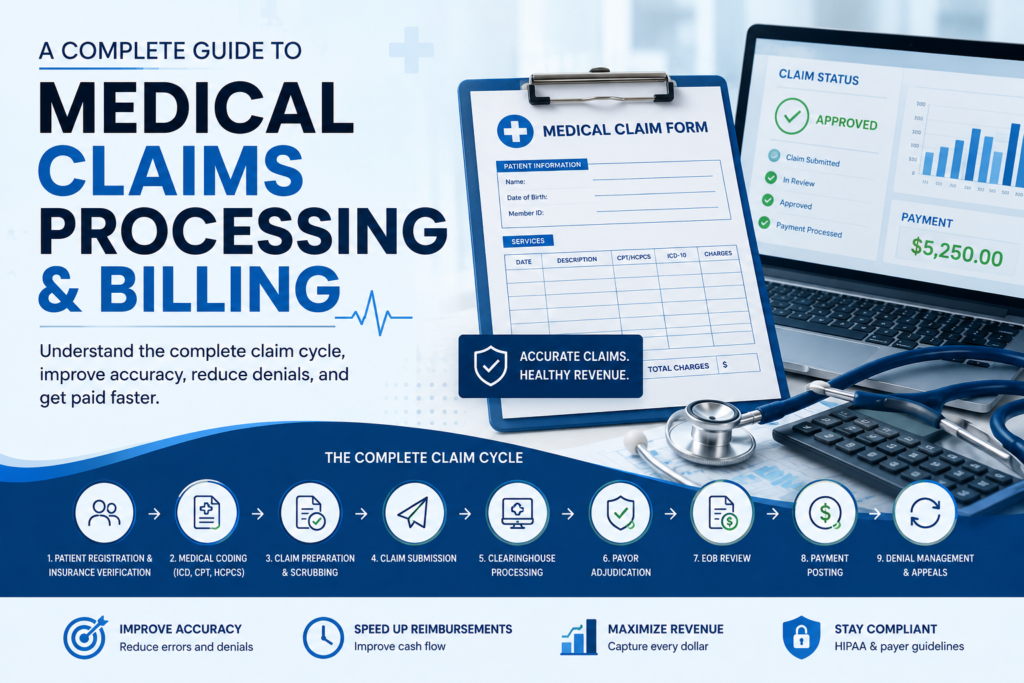
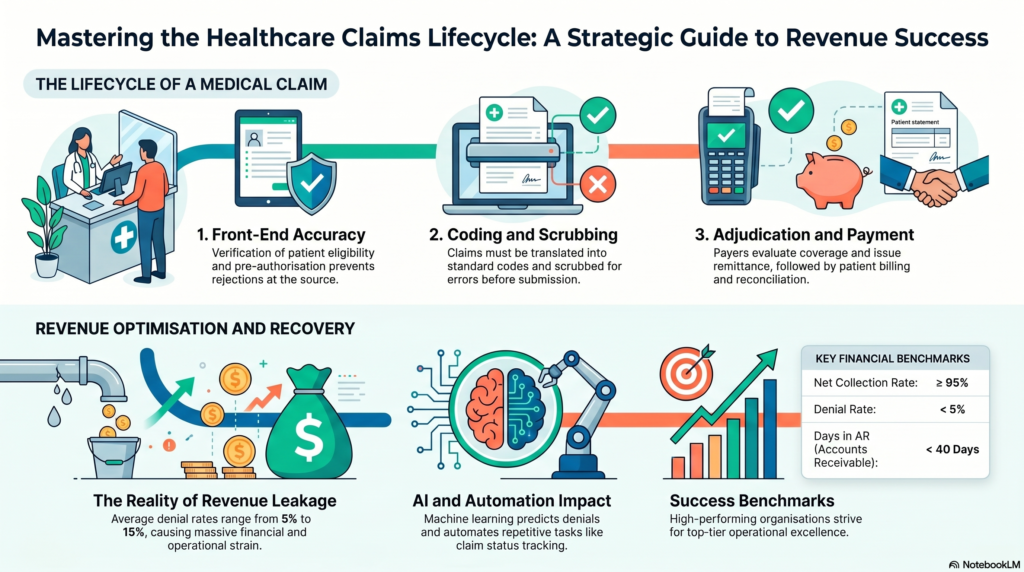
Introduction Every year, U.S. healthcare providers submit billions of medical claims — and a staggering portion of them are denied, delayed, or returned for corrections. The financial and operational consequences are enormous. Revenue leakage, administrative overload, and compliance risks are just a few of the pain points that emerge when claims management healthcare systems fail to perform at their best. Whether you are a hospital administrator, a billing professional, a health plan executive, or a technology vendor, understanding how claims management works — and how to make it work better — is not optional. It is a strategic imperative. This comprehensive guide walks you through every dimension of claims management in the healthcare industry. From the foundational claim cycle in medical billing to advanced claims management solutions, you will find actionable insights, practical frameworks, and expert guidance to help your organization reduce denials, accelerate reimbursement, and build a more resilient revenue cycle. Let’s start from the beginning.   What Is Claims Management in Healthcare?  Claims management in healthcare refers to the end-to-end administrative and clinical process of submitting, tracking, adjudicating, and reconciling medical claims between healthcare providers and payers (insurance companies, government programs, or self-pay patients). At its core, it answers one simple question: Did the provider get paid accurately and on time for the services they delivered? But the process to answer that question is anything but simple. It involves: Claims management healthcare spans multiple departments — clinical, administrative, financial, and compliance — and touches every patient encounter from registration to final payment. When all of these moving parts align, the result is a healthy revenue cycle. When they don’t, organizations face claim rejections, revenue delays, and compliance exposure. Medical Claims Management vs. General Claims Management It is worth distinguishing medical claims management from general insurance claims management (e.g., auto or property insurance). While both involve submitting and processing claims, medical claims management operates within a uniquely complex regulatory and clinical environment. Healthcare claims must comply with: This complexity is precisely why dedicated claims management solutions have become indispensable for healthcare organizations of all sizes. Why Claims Management Healthcare Matters  The stakes in healthcare claims management are extraordinarily high — financially, operationally, and clinically. The Financial Reality According to industry reports, healthcare providers in the United States lose billions of dollars annually due to claim denials, inefficient billing processes, and write-offs. The American Medical Association (AMA) has consistently reported that claim denials cost physician practices and hospitals significant administrative resources to resolve. Key financial impacts include: Effective claims management healthcare practices directly counter each of these financial threats. The Operational Reality Beyond dollars and cents, poor claims management creates operational chaos: The Compliance Reality Healthcare billing is one of the most heavily regulated areas of business. Errors in claims submission — intentional or accidental — can trigger audits, civil monetary penalties, or even exclusion from federal healthcare programs. A strong medical claims management framework is, therefore, also a compliance management strategy. The Complete Claim Cycle in Medical Billing  The claim cycle in medical billing describes the full journey of a healthcare claim — from the moment a patient schedules an appointment to the final resolution of their account. Understanding every stage of this cycle is essential for identifying where breakdowns occur and where improvements can be made. Stage 1: Patient Registration and Pre-Authorization The claim cycle begins before a single medical service is rendered. Patient registration captures demographic and insurance information. Accuracy here is critical — errors in patient name, date of birth, insurance ID, or group number will cascade into claim rejections downstream. Pre-authorization (or prior authorization) involves obtaining advance approval from the payer for specific services, procedures, or medications. Without it, certain claims will be automatically denied regardless of clinical necessity. This stage requires proactive communication between clinical staff, administrative teams, and the payer. Best practices at this stage: Stage 2: Clinical Service and Documentation Once the patient receives care, providers must document the encounter in a way that supports accurate billing. This is where clinical and administrative functions intersect. Clinical documentation must capture: Thorough documentation is not just a billing requirement — it is a clinical and legal obligation. Gaps in documentation are one of the leading causes of claim denials. Stage 3: Medical Coding Medical coding translates clinical documentation into standardized codes that payers use to adjudicate claims. This is one of the most technically demanding stages of the claim cycle in medical billing. Three primary code sets are used: Common coding errors that derail the claim cycle: Certified professional coders (CPCs) and certified coding specialists (CCSs) play a critical role in maintaining coding accuracy and compliance. Stage 4: Charge Capture and Claim Preparation Charge capture is the process of recording all billable services for a patient encounter and translating them into charges on the claim form. Incomplete charge capture — missing line items, incorrect units, or omitted services — leads to under-billing. The claim is then prepared using standardized forms: Electronic claims are transmitted in ANSI X12 EDI 837 format, with 837P for professional claims and 837I for institutional claims. Stage 5: Claim Submission in Medical Billing Claim submission in medical billing is the formal transmission of the completed claim to the payer for adjudication. This stage has evolved dramatically from paper-based processes to real-time electronic submission. Claims can be submitted: Using a clearinghouse is the most common approach for practices billing multiple payers. Clearinghouses perform a first-pass edit check that catches formatting errors, missing data, and invalid codes before the claim reaches the payer — preventing rejections that would delay payment. Stage 6: Payer Adjudication Once the payer receives the claim, the adjudication process begins. The payer evaluates the claim against: The payer’s system applies automated edits and, for complex claims, routes the claim for manual review by a claims examiner. The outcome is one of the following: Stage 7: Remittance and Payment Posting When the payer finalizes adjudication, it issues an Explanation of Benefits (EOB) to the patient and an Electronic Remittance

healthcare accounts receivable
Blog

Healthcare Accounts Receivable Process: Step-by-Step

Introduction Managing money in healthcare is never simple. Between insurance verifications, claim submissions, and patient payments, hospitals and clinics deal with a complex web of financial transactions every single day. At the center of it all is the healthcare accounts receivable process — the structured system that ensures providers actually get paid for the care they deliver. Healthcare accounts receivable (AR) refers to all the outstanding payments owed to a medical practice or healthcare organization after services have been rendered. These balances come from insurance companies, government payers like Medicare and Medicaid, and patients themselves. Without a well-managed AR process, even a thriving medical practice can face serious cash flow problems. This step-by-step guide breaks down the complete accounts receivable process in healthcare — from patient registration to payment posting — so billing teams, practice managers, and administrators can optimize collections, reduce denials, and strengthen their overall financial performance. What Is Healthcare Accounts Receivable? Healthcare accounts receivable is the total amount of money owed to a healthcare provider for services already delivered but not yet paid. It sits on the balance sheet as an asset and represents the financial backbone of most medical organizations. Unlike other industries, healthcare AR is uniquely complicated. Payments come from multiple sources — primary insurers, secondary insurers, and patients — each with their own rules, timelines, and claim requirements. A single patient visit can trigger a billing chain that lasts weeks or even months. Key AR metrics every practice should track: Tracking these KPIs is the first step toward effective healthcare accounts receivable management. The Accounts Receivable Process in Healthcare: Step-by-Step Step 1: Patient Registration and Insurance Verification The AR process begins before the patient even sees a doctor. Accurate patient registration is the foundation of clean billing. During registration, front-desk staff collect: After registration, the billing team performs insurance eligibility verification — confirming that the patient’s coverage is active, the provider is in-network, and the specific services are covered under the patient’s plan. Why this step matters: Errors at registration — a misspelled name, wrong policy number, or expired insurance — are among the top causes of claim denials. Getting it right here prevents costly rework downstream. Best practices for this step include verifying eligibility at least 48–72 hours before the appointment and using automated eligibility tools that connect directly to payer databases. Step 2: Patient Check-In and Financial Counseling On the day of the appointment, front-desk staff confirm registration details and collect any upfront patient financial responsibilities, such as: This is also when financial counseling should take place. For patients facing high-cost procedures, a financial counselor explains estimated out-of-pocket costs, available payment plans, and financial assistance options. Collecting copays and partial payments at the point of service dramatically reduces the patient AR balance that billing teams must chase later. Step 3: Medical Coding Once the patient is seen, the provider documents the encounter in the patient’s medical record. The coding team — or the provider, in smaller practices — translates that clinical documentation into standardized codes: Accurate coding is critical to the accounts receivable process in healthcare. Upcoding, undercoding, or mismatched diagnosis-procedure codes lead to claim denials, compliance risks, and delayed payments. Common coding errors that trigger denials: Coding audits — both internal and external — are an essential part of healthcare accounts receivable management. Step 4: Charge Entry and Claim Creation After coding, the billing team enters charges into the practice management system. Charge entry involves: Once charges are entered, the system generates a claim — typically in CMS-1500 format for professional billing or UB-04 format for facility billing. The claim bundles all the coded and demographic information into a structured file that payers can process. Before submission, claims go through a scrubbing process. The billing software checks for errors like missing fields, invalid codes, and formatting issues. Catching these problems at the scrubbing stage — rather than after rejection — is key to maintaining a high clean claim rate in accounts receivable medical billing. Step 5: Claim Submission to Payers With the claim scrubbed and approved, the billing team submits it to the appropriate payer. Claims are submitted in two ways: Clearinghouse role in AR: A clearinghouse acts as an intermediary between the provider and the payer. It validates claims, translates them into payer-specific formats, and routes them to hundreds of different insurance companies. Using a robust clearinghouse reduces rejection rates significantly. Timely filing deadlines vary by payer. Medicare typically requires claims within 12 months of the service date; commercial payers may impose 90-day or 180-day windows. Missing a filing deadline means the claim is denied with no right to appeal — a preventable revenue loss that directly impacts the healthcare revenue cycle. Step 6: Payment Posting Once the payer processes the claim, they issue an Explanation of Benefits (EOB) or, for electronic payments, an Electronic Remittance Advice (ERA). These documents detail: The billing team then posts these payments to the patient accounts in the practice management system. Accurate payment posting is essential because it: Secondary billing: If the patient has secondary insurance, the billing team submits a crossover claim (or a manually prepared secondary claim) with the primary EOB attached, so the secondary payer knows what has already been paid. Step 7: Denial Management Denials are a fact of life in accounts receivable management in medical billing. No matter how efficient the billing team, some claims will be rejected or denied. The difference between high-performing and struggling practices is how quickly and effectively they respond. Common denial reasons: The denial management workflow: Strong denial management is the single biggest lever in improving revenue cycle management in healthcare. Reducing denials by even a few percentage points can translate to tens of thousands of dollars in recovered revenue. Step 8: Accounts Receivable Follow-Up Claims that are neither paid nor denied within a reasonable timeframe — typically 30 to 45 days — require active follow-up. This is one of the most labor-intensive parts of the accounts receivable process in healthcare, but also

revenue cycle management
Revenue Cycle Management

Revenue Cycle Management in Medical Billing: The Complete Guide

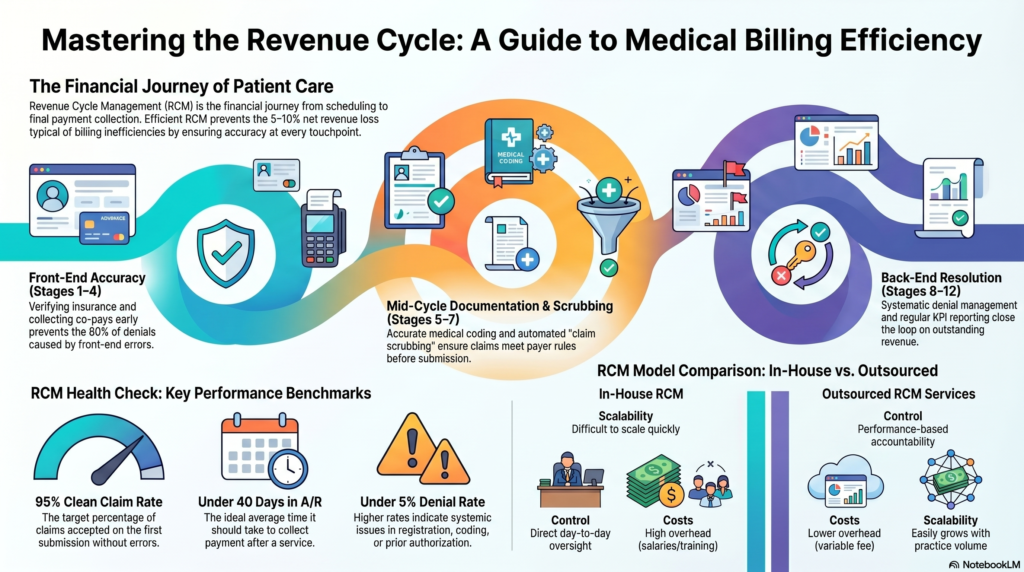
Introduction Every healthcare provider — from a solo family physician to a large hospital network — faces the same operational reality: delivering great care is only half the battle. Getting paid for that care is the other half. And that is precisely where revenue cycle management in medical billing becomes mission-critical. Whether you run a small clinic, a specialty practice, or a multi-location healthcare organization, a poorly managed revenue cycle costs you thousands of dollars every month in denied claims, missed charges, and administrative inefficiency. On the other hand, a well-optimized revenue cycle management process ensures that every service you render translates into timely, accurate reimbursement. This guide covers everything you need to know: what RCM in medical billing means, how the RCM cycle in medical billing works end to end, what revenue cycle management services include, and how to choose the right approach for your practice. By the end, you will have a clear roadmap to protect your revenue, reduce billing errors, and improve your practice’s financial health. What Is Revenue Cycle Management in Medical Billing? Revenue cycle management (RCM) is the financial process that healthcare organizations use to track patient care episodes — from the initial appointment scheduling all the way through to the final payment collection. In the context of medical billing, RCM refers specifically to the administrative and clinical functions that contribute to capturing, managing, and collecting patient service revenue. Simply put, RCM in medical billing is the system that ensures you get paid correctly, completely, and on time for the healthcare services you provide. The term “revenue cycle” describes the entire journey of a single healthcare transaction: Any breakdown at any point in this journey results in delayed payments, underpayments, or outright claim denials. That is why managing this cycle with precision and expertise is not optional — it is essential for financial sustainability. Why RCM Matters More Than Ever Healthcare billing has grown exponentially complex over the past decade. The transition to ICD-10 coding, the rise of value-based care models, the increasing patient financial responsibility shift due to high-deductible health plans, and the constant evolution of payer policies have all raised the stakes. According to industry data, physician practices lose an estimated 5–10% of net revenue due to billing inefficiencies. For a practice generating $2 million annually, that represents $100,000 to $200,000 in preventable revenue loss every year. Effective revenue cycle management is the solution. The Complete RCM Cycle in Medical Billing — Step by Step Understanding the RCM cycle in medical billing is the foundation of improving your revenue performance. The cycle consists of several interconnected stages, each building on the last. Let’s walk through each one. Stage 1: Patient Pre-Registration and Scheduling The revenue cycle begins before the patient ever walks through the door. During pre-registration, staff collect: Accurate pre-registration is critical. A simple typo in a patient’s name or insurance ID number can cause a claim to be rejected weeks later. Many practices use automated tools to verify information at this stage, saving significant rework downstream. Stage 2: Insurance Eligibility and Benefits Verification Before the patient is seen, your billing team must verify that their insurance is active and confirm what their plan covers. This includes: Eligibility verification is one of the highest-impact steps in the rcm cycle in medical billing. Skipping or rushing it causes a cascade of billing problems, including claim denials for inactive coverage or missing authorizations. Stage 3: Prior Authorization Some procedures, medications, and diagnostic tests require advance approval from the insurance company before they are performed. Failing to obtain prior authorization — or not following up when one is pending — is a leading cause of claim denials. Robust revenue cycle management workflows include automated prior authorization tracking and escalation protocols so that no authorization is missed or expired. Stage 4: Patient Check-In and Copayment Collection When the patient arrives, your front desk staff should: Collecting copayments at the point of service dramatically improves collection rates. The cost and effort of collecting patient balances post-visit are significantly higher — and many balances are never collected at all. Stage 5: Medical Coding Once the provider completes the encounter, clinical documentation is translated into standardized codes. Medical coding involves: Accurate coding is essential for clean claim submission. Under-coding leaves money on the table. Over-coding can trigger audits and compliance issues. Correct coding — based on complete and precise clinical documentation — is the target. Skilled medical coders are in high demand precisely because this step requires both deep clinical knowledge and expertise in billing guidelines from CMS, AMA, and individual payers. Stage 6: Charge Capture and Claim Creation After coding, charges are entered into the billing system and a claim is assembled. The claim must include: Charge capture audits help identify missed charges — services performed but never billed — which is a common but often overlooked source of revenue leakage. Stage 7: Claim Scrubbing and Submission Before a claim is sent to the payer, it goes through a “scrubbing” process. Claim scrubbing checks for: Clean claims — those that pass all edits — are submitted electronically to the appropriate payer. The goal is to achieve a clean claim rate above 95%, which means fewer denials and faster payment. Stage 8: Payer Adjudication Once the payer receives the claim, they review it against their coverage policies, fee schedules, and member benefits. The payer will: This process can take anywhere from a few days to several weeks, depending on the payer and the complexity of the claim. Stage 9: Payment Posting and Reconciliation When payment arrives — from the insurer as an Explanation of Benefits (EOB) or from the patient — it must be accurately posted to the correct patient account. Payment posting includes: Accurate payment posting keeps accounts current and feeds into the denial analysis process. Stage 10: Denial Management and Appeals Denied claims are a reality in any medical billing operation. Effective RCM in medical billing requires a structured denial management process: Practices that don’t actively

medical billing outsourcing
Blog

Medical Billing Outsourcing: Save Costs & Boost ROI

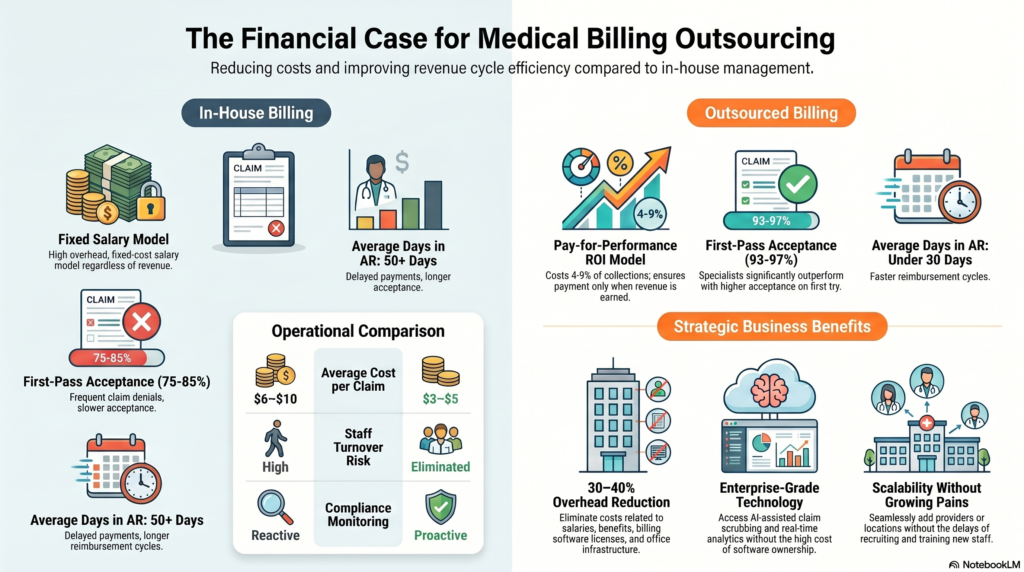
Introduction Running a healthcare practice is demanding enough without wrestling with billing errors, claim denials, and mounting administrative overhead. Medical billing outsourcing offers a proven solution — letting specialized teams handle your revenue cycle while you focus on patient care. In this guide, you’ll discover how outsourcing medical billing services reduces operational costs, accelerates cash flow, and significantly boosts your practice’s ROI. Whether you’re a solo practitioner or managing a multi-specialty group, the right outsourcing partner can transform your bottom line. What Is Medical Billing Outsourcing? Medical billing outsourcing is the practice of delegating billing and revenue cycle management tasks to a third-party provider. Instead of maintaining an in-house billing department, healthcare practices partner with specialized companies that manage the entire billing lifecycle — from claim submission and coding to follow-up and payment posting. These services typically cover: When you outsource billing services, you gain access to certified coders, advanced billing software, and dedicated AR specialists — without the overhead of building that team internally. Why Practices Are Choosing to Outsource Medical Billing Services The financial pressure on healthcare providers continues to intensify. Rising labor costs, complex payer rules, and escalating denial rates make in-house billing increasingly expensive and error-prone. Here’s why more practices are choosing to outsource medical billing services: 1. Skyrocketing In-House Billing Costs Maintaining an internal billing team comes with hidden expenses many practices underestimate: A certified medical biller can cost $45,000–$65,000 per year in salary alone — before benefits. Multiply that across a team, and the numbers add up fast. 2. High Claim Denial Rates Drain Revenue The American Medical Association reports that the average claim denial rate across U.S. practices hovers between 5% and 10%. Each denied claim represents lost revenue, rework time, and delayed payments. Professional outsource billing companies employ denial management specialists who track, analyze, and appeal denied claims aggressively — recovering revenue that would otherwise be written off. 3. Regulatory Complexity and Compliance Risk Healthcare billing regulations change frequently. Staying current with ICD-10 updates, payer-specific requirements, and HIPAA standards requires dedicated expertise. Non-compliance can result in audits, penalties, and reputational damage. Medical billing outsourcing companies maintain compliance teams whose sole focus is keeping your billing practices within regulatory boundaries. 4. Technology Gaps in Small Practices Top-tier revenue cycle management software can cost thousands of dollars annually. Outsourced billing partners bring enterprise-grade technology to your practice at a fraction of the cost — including AI-assisted claim scrubbing, real-time analytics dashboards, and automated eligibility checks. How Medical Billing Outsourcing Reduces Costs Cost reduction is one of the primary drivers for outsourcing — and the savings can be substantial. Lower Overhead Costs When you outsource billing services, you eliminate or dramatically reduce: Many practices report overhead reductions of 30–40% after switching to an outsourced model. Pay-for-Performance Pricing Models Most medical billing outsourcing companies charge a percentage of collections — typically 4% to 9% — which means you only pay when they successfully collect revenue. This aligns incentives perfectly: your partner earns more only when your practice earns more. Compare this to a fixed salary model where in-house staff are paid regardless of collections performance. Reduced Write-Offs and Improved First-Pass Rates Experienced outsource billing companies consistently achieve first-pass claim acceptance rates above 95%. Higher first-pass rates mean faster payments, fewer denials to chase, and dramatically reduced write-offs. Even a 5% improvement in collections on a $1 million revenue practice translates to an additional $50,000 per year flowing back to the practice. How Outsourcing Medical Billing Boosts ROI Cost savings are just half the equation. Outsourcing medical billing services also directly accelerates revenue — driving meaningful ROI improvements. Faster Reimbursement Cycles In-house billing teams often deal with backlogs, staff turnover, and training gaps that slow down claim submissions. Outsourced teams maintain dedicated workflows and staffing levels that ensure claims go out quickly and consistently. Faster submissions mean faster payments — reducing the average days in accounts receivable (DAR) from 50+ days to under 30 days for many practices. Denial Prevention Through Proactive Coding Expert medical coders identify coding errors before submission rather than after denial. This proactive approach — rather than the reactive “submit and fix” cycle — prevents revenue leakage at the source. Leading outsource billing companies use claim scrubbing software that cross-checks codes against payer-specific edits, virtually eliminating technical denials. Scalability Without Growing Pains As your practice grows, your billing needs scale with it. Hiring and training new in-house staff takes time and resources. With medical billing outsourcing, your provider scales up capacity seamlessly — no recruitment delays, no dip in performance. This scalability is particularly valuable for practices expanding to new locations, adding providers, or launching new service lines. Transparency and Data-Driven Insights Modern outsource billing companies provide detailed performance dashboards, monthly reports, and real-time analytics. These insights reveal: Armed with this data, practice administrators and physicians can make smarter decisions about payer contracts, staffing, and service mix. What to Look for in Medical Billing Outsourcing Companies Not all outsource billing companies deliver the same results. Choosing the wrong partner can create bigger headaches than managing billing in-house. Here’s what to evaluate: Specialty Experience Medical billing varies significantly across specialties. A company experienced in orthopedics may lack the nuanced coding knowledge required for behavioral health or oncology. Always verify that your shortlisted medical billing outsourcing companies have demonstrated experience in your specific specialty. Certifications and Compliance Standards Look for companies with certified coders (CPC, CCS) and documented HIPAA compliance programs. Ask about their data security protocols, Business Associate Agreement (BAA) policies, and breach response procedures. Technology Stack Ask what practice management and billing software they support. The best outsource billing companies integrate seamlessly with your existing EHR — whether that’s Epic, Athenahealth, eClinicalWorks, or another platform. Transparent Pricing Be wary of providers who aren’t upfront about their fee structure. Reputable medical billing outsourcing companies clearly explain whether they charge a flat fee, per-claim rate, or percentage of collections — and what’s included. Client References and Proven Results Request case studies or references from

Medical billing services
Blog

Medical Billing Services: Complete Guide for Providers

Introduction Running a successful healthcare practice means more than delivering excellent patient care — it also means getting paid accurately and on time. Medical billing services have become essential for providers who want to reduce claim denials, speed up reimbursements, and eliminate the administrative burden that drains staff time and energy. Whether you are a solo practitioner, a specialty clinic, or a multi-location healthcare group, understanding how professional medical billing works can transform your practice’s financial health. This complete guide walks you through everything you need to know — from the basics of medical billing to finding trusted medical billing services near me and implementing a robust revenue cycle management strategy. What Are Medical Billing Services? Medical billing services are specialized solutions that handle the process of submitting, tracking, and collecting payments for healthcare services rendered by providers. Instead of managing in-house billing staff, many practices outsource this function to dedicated billing companies or use advanced billing software platforms. These services cover the full lifecycle of a claim — from patient registration and insurance verification to claim submission, denial management, and final payment posting. Who Needs Medical Billing Services? Medical billing solutions serve a wide range of healthcare providers, including: Regardless of size or specialty, any provider that accepts insurance or processes patient payments can benefit from professional billing support. How Does the Medical Billing Process Work? Understanding the step-by-step flow of medical billing helps providers appreciate the complexity involved and the value that expert billing teams bring to the table. Step 1: Patient Registration and Insurance Verification Before a patient is seen, billing teams verify insurance eligibility and coverage details. This prevents claim rejections caused by inactive policies or inaccurate demographic information. Step 2: Medical Coding Clinical documentation from the visit is translated into standardized codes — ICD-10 diagnosis codes and CPT procedure codes. Accurate coding is critical. Even minor coding errors can trigger denials or compliance audits. Step 3: Claim Submission Clean claims are submitted electronically to insurance payers. Timely submission is essential, as most payers enforce filing deadlines that, if missed, result in permanent non-payment. Step 4: Payment Posting and Denial Management Once payers process claims, payments are posted to patient accounts. When claims are denied, billing specialists review the reason, correct any errors, and resubmit. This appeals process is where expert billing teams truly demonstrate their value. Step 5: Patient Billing and Collections After insurance pays its portion, any remaining balance is billed to the patient. Professional billing services handle this diplomatically, protecting patient relationships while ensuring collections. Key Benefits of Outsourcing Medical Billing Solutions Outsourcing medical billing solutions offers measurable advantages over relying entirely on in-house staff. Here is why thousands of providers are making the switch. 1. Increased Revenue and Faster Reimbursements Professional billing teams know how to submit cleaner claims the first time, reducing the denial rate significantly. Faster approvals mean money reaches your practice sooner — improving cash flow and financial stability. 2. Reduced Administrative Burden Billing is time-consuming. When your front desk and clinical staff are focused on billing tasks, patient care suffers. Outsourcing frees your team to concentrate on what they do best — caring for patients. 3. Lower Overhead Costs Hiring, training, and retaining in-house billing staff is expensive. Add the cost of billing software, compliance training, and employee benefits, and the numbers add up quickly. Medical billing services typically charge a percentage of collections — meaning you only pay when you get paid. 4. Compliance and Regulatory Expertise Healthcare billing regulations change constantly. HIPAA requirements, payer-specific rules, and coding guideline updates demand ongoing education. Professional billing companies stay current so your practice remains compliant and audit-ready. 5. Access to Real-Time Reporting Most modern medical billing services provide dashboards and reports that show your practice’s financial health at a glance — from days in accounts receivable to denial rates and collection performance. Understanding Revenue Cycle Management in Medical Billing Revenue cycle management in medical billing (RCM) refers to the end-to-end process of managing the financial interactions between a patient and a healthcare provider. It begins at the moment a patient schedules an appointment and ends when every dollar owed has been collected. Medical revenue cycle management is broader than billing alone. It encompasses: Why Revenue Cycle Management Matters A fragmented revenue cycle is one of the top reasons healthcare practices lose money without realizing it. Studies consistently show that 5–10% of medical claims are denied on the first submission, and many of those denials are never reworked — leaving significant revenue uncollected. Effective medical revenue cycle management closes those gaps. By identifying bottlenecks, correcting front-end errors, and aggressively managing denials, RCM specialists help practices recover revenue that would otherwise be written off. In-House RCM vs. Outsourced RCM Factor In-House RCM Outsourced RCM Cost Fixed (salaries, training, software) Variable (% of collections) Expertise Limited to staff knowledge Dedicated specialists Scalability Difficult to scale quickly Easily scalable Technology Requires investment Included in service Compliance updates Staff must be retrained Handled by provider For most small to mid-sized practices, outsourced medical revenue cycle management delivers a stronger return on investment. How to Find Medical Billing Services Near Me Searching for medical billing services near me can feel overwhelming given the number of providers in the market. Here is a practical framework to evaluate your options and choose the right partner. 1. Evaluate Their Specialty Experience Not all billing companies handle all specialties equally. A billing firm experienced in mental health coding may not have deep expertise in surgical specialties. Always ask for references from providers in your specific specialty. 2. Check Their Technology Stack Modern billing services should integrate seamlessly with your electronic health record (EHR) system. Ask about their practice management software, clearinghouse partnerships, and real-time reporting capabilities. 3. Review Their Track Record Ask potential billing partners about their: 4. Understand Their Pricing Model Most billing companies charge between 4–9% of monthly collections, depending on specialty and volume. Be cautious of flat-fee models that do not incentivize strong collection performance.

revenue cycle management
Blog

What is Revenue Cycle Management? A Complete Guide to RCM Services

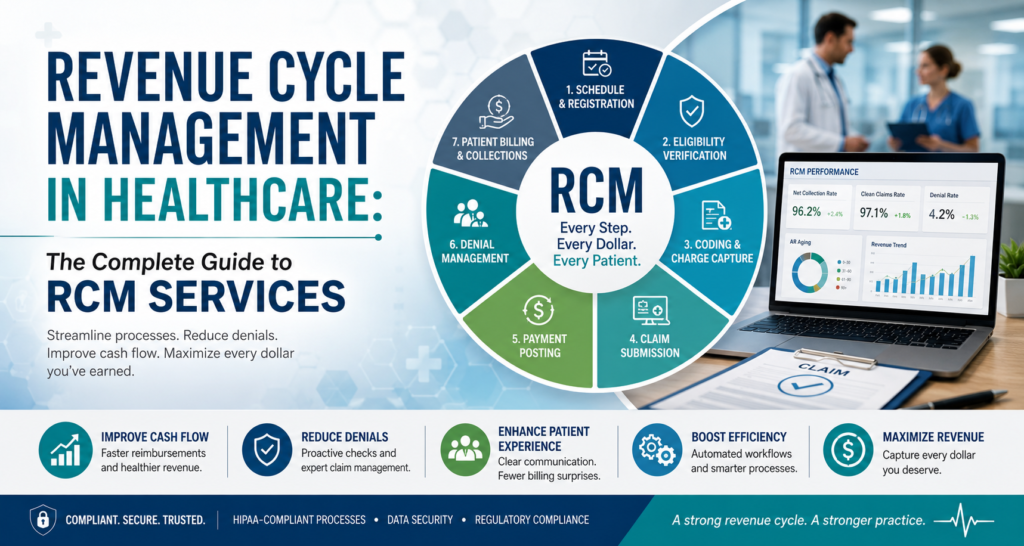
Introduction If your healthcare organization is losing money to claim denials, billing errors, or slow reimbursements, the problem likely lives inside your revenue cycle. Revenue cycle management (RCM) is the financial backbone of every healthcare practice — from the moment a patient schedules an appointment to the moment the final payment clears. In this complete 2026 guide, we break down everything you need to know about RCM services: what they are, how they work, why they matter, and how the right revenue cycle management services can transform your organization’s financial health. Whether you’re a hospital CFO, a private practice manager, or a healthcare administrator, this guide is built for you. What Is Revenue Cycle Management? Revenue cycle management is the process healthcare providers use to track patient care episodes — from registration and appointment scheduling all the way through to final payment collection. It encompasses every administrative and clinical function that contributes to the capture, management, and collection of patient service revenue. In simpler terms, RCM connects the clinical side of healthcare with the financial side. It ensures that for every service delivered, the provider gets paid accurately and on time. The “revenue cycle” begins when a patient first contacts a provider and ends when the account balance reaches zero — either through insurance reimbursement, patient payment, or a combination of both. Key Components of the Revenue Cycle The revenue cycle is not a single process. It is an interconnected chain of steps, each of which must function correctly for the whole system to work: When any one of these steps breaks down, revenue leaks out of the system — and that leakage adds up fast. Why Revenue Cycle Management Matters in 2026 The stakes for healthcare revenue management have never been higher. Payer rules grow more complex every year, coding requirements evolve, and patients are shouldering larger portions of their care costs through high-deductible health plans (HDHPs). According to industry data, healthcare providers write off billions of dollars annually due to claim denials, billing errors, and uncollected patient balances. A well-structured revenue cycle management system directly addresses these losses. Here is why RCM has become mission-critical for modern healthcare organizations: Rising claim denial rates. Payers are denying more claims than ever before, often for technical reasons that could have been prevented. Every denied claim costs money to rework — and some are never recovered at all. Increased patient financial responsibility. With more patients enrolled in HDHPs, practices must now collect significant sums directly from individuals — a process that requires clear billing communication, flexible payment options, and proactive outreach. Regulatory complexity. Compliance requirements around coding, documentation, and billing continue to evolve. Errors can result in audits, repayments, or penalties. Staffing pressures. Finding and retaining skilled billing staff remains a major challenge. Outsourced or tech-enabled RCM services help bridge this gap without sacrificing quality. Thin operating margins. Hospitals and practices are operating on tighter margins than ever. Maximizing revenue capture is essential to financial sustainability. What Are RCM Services? RCM services refer to the full suite of professional solutions designed to manage and optimize the revenue cycle on behalf of a healthcare provider. These services can be delivered by specialized third-party vendors, integrated software platforms, or a combination of both. Think of RCM services as a managed solution for your billing and collections infrastructure — one that brings expertise, technology, and proven processes to replace or augment your in-house capabilities. Types of RCM Services Available 1. End-to-End Revenue Cycle Management Services These comprehensive solutions handle the entire revenue cycle — from patient access through final payment. Providers hand off the full billing and collections function to a specialized partner, retaining oversight through reporting dashboards and regular performance reviews. End-to-end revenue cycle management services are ideal for: 2. Front-End RCM Services Front-end services focus on activities that occur before and at the point of care. These include: Getting the front end right is crucial — errors made before a patient ever sees a provider can cascade through the entire revenue cycle and result in denials weeks later. 3. Mid-Cycle RCM Services Mid-cycle services center on documentation and coding: Accurate, complete documentation is the foundation of every clean claim. Mid-cycle RCM services ensure that what happens in the exam room translates correctly onto the claim form. 4. Back-End RCM Services Back-end services focus on claims after submission: For many practices, the back end is where revenue most commonly slips through the cracks. Denied claims that sit unworked age out of timely filing limits, and patient balances that go unpursued become bad debt. 5. RCM Technology Platforms Technology-enabled RCM services increasingly include AI-powered tools that automate repetitive tasks, flag coding errors before submission, predict denial likelihood, and prioritize AR follow-up queues. These platforms integrate with your existing EHR/PM systems and provide real-time visibility into revenue performance. How Revenue Cycle Management Services Work: Step by Step Understanding how revenue cycle management services function in practice helps you evaluate vendors and set realistic expectations for results. Here is a typical workflow: Step 1: Patient Access and Eligibility Verification Before a patient arrives, the RCM team verifies insurance eligibility, checks for active coverage, identifies any authorization requirements, and collects any outstanding patient balances. This step alone eliminates a large category of downstream claim denials. Step 2: Charge Capture and Medical Coding Following the patient encounter, clinical documentation is reviewed and coded by certified medical coders. RCM services employ coders credentialed in CPC, CCS, or specialty-specific certifications to ensure accuracy and compliance. Charge capture audits confirm that every billable service is actually billed — catching missed revenue that would otherwise go uncollected. Step 3: Claims Scrubbing and Submission Before a claim is submitted to a payer, it passes through a claims scrubbing engine that checks for errors: missing information, coding mismatches, incorrect patient demographics, or authorization gaps. Clean claims go out electronically, typically within 24–48 hours of the encounter. Step 4: Payment Posting and Reconciliation When payments arrive from insurers, they are posted to the correct

Medical billing services
Blog

Medical Billing Services: How Outsourcing Improves Revenue Cycle Efficiency for Healthcare Providers

Healthcare providers today face many operational challenges—patient care demands, insurance complexities, and administrative tasks. Among these, managing billing processes accurately and efficiently is one of the most critical responsibilities. Hospitals, clinics, and independent physicians rely on efficient billing operations to maintain healthy cash flow and ensure financial stability. This is where medical billing services play a vital role. Professional billing companies help healthcare organizations manage claims, payments, coding, and insurance communications effectively. Instead of spending valuable time on complicated billing procedures, medical professionals can focus on patient care while experts handle revenue cycle management. In this blog, we will explore what medical billing services are, how they work, the benefits of outsourcing billing operations, and how providers can find reliable medical billing services near me to improve their practice performance. What Are Medical Billing Services? Medical billing services involve managing the financial processes between healthcare providers, insurance companies, and patients. These services ensure that medical procedures performed by doctors are accurately coded, billed, and reimbursed by insurance providers. The billing process usually includes: Professional medical billing services ensure accuracy and compliance with healthcare regulations such as HIPAA and payer-specific requirements. Without efficient billing management, healthcare practices may experience delayed payments, claim denials, and revenue losses. Because billing rules and insurance requirements constantly change, many healthcare providers choose medical billing outsourcing to ensure that their billing operations remain efficient and compliant. How Medical Billing Services Work Understanding how medical billing services operate helps healthcare providers see the value of outsourcing billing tasks. 1. Patient Registration and Insurance Verification The billing process begins when a patient schedules an appointment. Accurate patient details and insurance information are collected to ensure correct claim submission. 2. Medical Coding Healthcare providers document patient diagnoses and procedures. Certified coders convert this information into standardized codes such as ICD-10, CPT, and HCPCS. 3. Claim Creation and Submission Billing professionals prepare claims based on the coded information and submit them electronically to insurance companies for reimbursement. 4. Insurance Review and Payment Insurance providers review claims to determine coverage eligibility. Once approved, payments are sent to the healthcare provider. 5. Denial Management If claims are denied or rejected, billing teams investigate the issue, correct errors, and resubmit claims promptly. 6. Patient Billing Any remaining balance after insurance payments is billed directly to the patient. By outsourcing these steps through medical billing outsourcing, healthcare practices can reduce administrative burden and improve efficiency. Benefits of Medical Billing Services for Healthcare Providers Using professional medical billing services offers many advantages for clinics, hospitals, and independent practitioners. 1. Improved Revenue Cycle Management Professional billing teams ensure that claims are submitted correctly and quickly. This reduces delays and increases the likelihood of faster reimbursements. 2. Reduced Claim Denials Errors in coding or documentation can cause claim rejections. Experienced billing specialists review claims thoroughly to minimize mistakes. 3. Cost Savings Hiring an in-house billing team requires salaries, training, and software investments. Medical billing outsourcing helps healthcare providers reduce operational costs while maintaining high efficiency. 4. Compliance With Regulations Healthcare billing regulations frequently change. Outsourced billing companies stay updated with industry guidelines to ensure compliance. 5. Focus on Patient Care Doctors and medical staff can concentrate on delivering quality care instead of managing billing complexities. 6. Access to Advanced Technology Professional medical billing services often use advanced billing software, analytics tools, and automated systems to improve accuracy and performance. 7. Better Financial Transparency Billing companies provide detailed reports and analytics that help healthcare providers monitor revenue performance. How to Choose the Best Medical Billing Services Finding reliable medical billing services near me requires careful evaluation. Healthcare providers should consider the following factors before selecting a billing partner. 1. Industry Experience Choose a billing provider with experience handling your specific medical specialty. 2. Compliance and Security Ensure that the billing service follows HIPAA regulations and protects sensitive patient data. 3. Transparent Pricing Reliable companies provide clear pricing structures without hidden fees. 4. Technology Integration The billing provider should integrate with your electronic health record (EHR) system. 5. Reporting and Analytics Detailed performance reports help healthcare providers track revenue and billing efficiency. Many clinics search online for medical billing services near me to find trusted providers who understand local healthcare requirements. Why Medical Billing Outsourcing Is Growing in Healthcare Healthcare organizations worldwide are increasingly adopting medical billing outsourcing to streamline operations. Several reasons explain this growing trend: By partnering with expert billing companies, healthcare providers can improve financial performance without expanding their internal administrative teams. In addition, medical billing services near me allow local providers to collaborate with experienced professionals who understand regional payer networks and healthcare systems. Challenges Solved by Medical Billing Services Healthcare providers often struggle with multiple billing-related challenges. Some of the most common issues include: Professional medical billing services address these issues by implementing structured billing workflows and quality control processes. With medical billing outsourcing, healthcare organizations can also scale their operations easily as patient volume increases. Frequently Asked Questions  1. What are medical billing services? Medical billing services manage the process of submitting healthcare claims to insurance companies and ensuring that providers receive accurate reimbursement for medical services. 2. Why should healthcare providers consider medical billing outsourcing? Medical billing outsourcing helps reduce administrative workload, improve billing accuracy, lower operational costs, and increase revenue cycle efficiency. 3. How do I find reliable medical billing services near me? Healthcare providers can search online, review service providers, and evaluate their experience, technology, compliance standards, and customer support. 4. Are medical billing services suitable for small clinics? Yes. Small clinics benefit greatly from medical billing services because outsourcing allows them to access professional billing expertise without hiring a large in-house team. 5. How do billing companies reduce claim denials? Experienced billing teams review documentation, verify insurance information, and ensure accurate coding before submitting claims. 6. Is patient data safe with outsourced billing services? Reputable medical billing outsourcing companies follow strict HIPAA compliance standards and use secure systems to protect patient data.

Scroll to Top