

Introduction
Medical claims processing is the backbone of every healthcare practice’s revenue cycle. Without a clean, efficient medical claims processing workflow, even the most successful provider will struggle with delayed reimbursements, denied claims, and mounting administrative burdens. Whether you run a solo practice or a large multi-specialty clinic, understanding how healthcare claims processing works — from the moment a patient walks in to the moment payment lands in your account — is essential for financial sustainability.
This guide breaks down every stage of the medical billing claims process in plain language. You will learn what medical claims processing involves, how the claim cycle in medical billing flows, what claims management solutions exist, and why many providers are turning to outsourced medical claims management to protect their revenue. By the end, you will have a clear picture of what it takes to get claims paid accurately and on time.
What Is Medical Claims Processing?
Medical claims processing is the system where health care providers send requests to payers to receive payment for a service provided to a patient. After examining the claim, the payer will process the request, and if there are no issues, they will send payment. If there is a problem with the claim, the payer will send a reason code explaining why payment will not be made.
The medical billing claims process involves far more than simply sending an invoice. It requires precise documentation, strict adherence to coding standards, compliance with HIPAA regulations, and an in-depth understanding of each Payor’s individual rules and fee schedules. A single coding error or missing piece of patient information can cause a claim to be denied — delaying cash flow and triggering a costly appeal process.
In short, medical claims processing sits at the intersection of clinical care and financial operations. Getting it right requires both medical knowledge and administrative expertise.
The Full Claim Cycle in Medical Billing
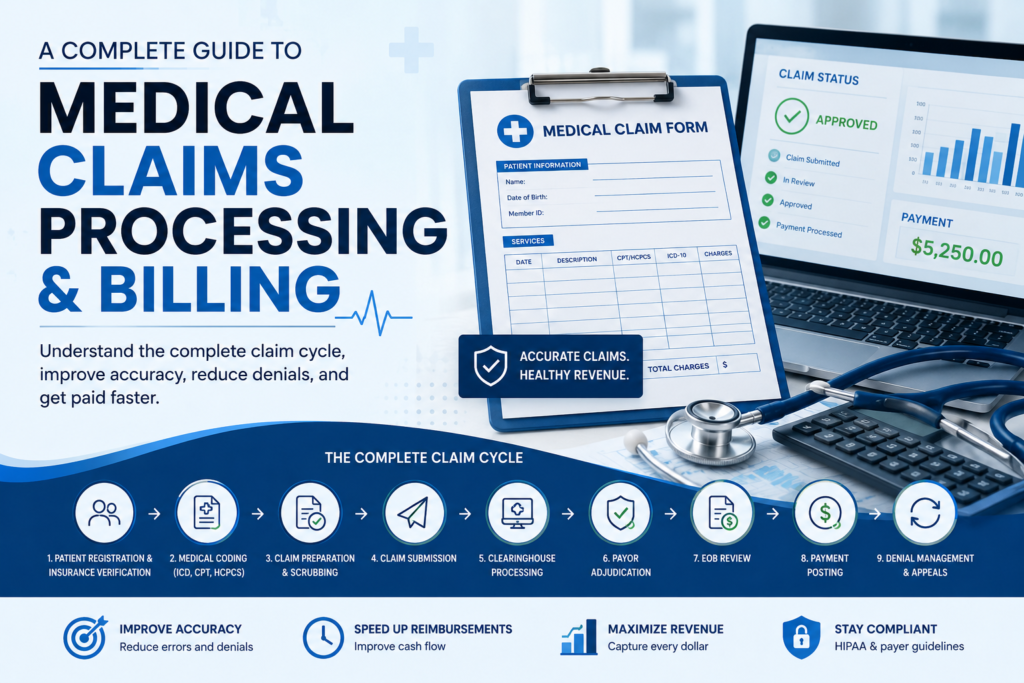
Understanding the complete claim cycle in medical billing is essential before diving into individual steps. The cycle begins at patient registration and ends only when the final payment is posted. Here is how each phase connects:
- Patient Registration and Insurance Verification
- Medical Coding (ICD and CPT)
- Claim Preparation and Scrubbing
- Claim Submission in Medical Billing
- Clearinghouse Processing
- Payor Adjudication
- Explanation of Benefits (EOB) Review
- Payment Posting
- Denial Management and Appeals
Each stage of this claim cycle in medical billing depends on the accuracy of the previous one. A mistake at step two — wrong CPT code — will create a cascade of problems all the way through to step nine. This interdependency is exactly why healthcare claims processing requires skilled professionals at every touchpoint.
Step 1 — Patient Registration and Insurance Verification
The workflow of medical claims processing begins before the patient receives any service. It starts with the registration process for the patient when the staff at the front desk collects and verifies necessary patient information.
- Full legal name, date of birth, and contact information
- Insurance carrier name, policy number, and group number
- Primary and secondary insurance coverage details
- Prior authorizations, if required by the payer
Insurance verification confirms that the patient’s policy is active, that the provider is in-network, and that the intended services are covered. Skipping this step is one of the leading causes of claim denials. Robust claims management solutions automate eligibility verification to reduce manual errors and speed up the entire healthcare claims processing pipeline.
Step 2 — Medical Coding: ICD, CPT, and HCPCS
Medical coding is the technical heart of the medical billing claims process. Every diagnosis, procedure, and service must be translated into universally recognized alphanumeric codes before claims can be submitted to insurers.
ICD Codes (International Classification of Diseases): These codes describe the patient’s diagnosis. The current version, ICD-10-CM, contains more than 70,000 codes covering every clinical condition. Selecting the most specific, accurate ICD code is critical for medical claims processing because Payors use diagnosis codes to determine medical necessity.
CPT Codes (Current Procedural Terminology): These codes describe the services and procedures performed. Maintained by the American Medical Association (AMA), CPT codes tell the Payor exactly what treatment was delivered.
HCPCS Codes (Healthcare Common Procedure Coding System): Used primarily for Medicare and Medicaid claims, HCPCS Level II codes cover equipment, supplies, and non-physician services not listed in the CPT set.
Correct coding is non-negotiable in medical claims management. Upcoding (billing for a higher level of service than provided) constitutes fraud, while downcoding (underreporting services) leads to revenue loss. Certified coders with current training in healthcare claims processing systems are indispensable for this step.
Step 3 — Claim Preparation and Scrubbing
Once coding is complete, the billing team prepares the claim for submission. A complete medical claim must include:
- Patient demographic information
- Provider NPI (National Provider Identifier) and tax ID
- Insurance plan and policy information
- Diagnosis codes (ICD-10)
- Procedure codes (CPT/HCPCS)
- Dates of service
- Place of service codes
- Charge amounts for each service
Before the claim leaves the practice, it should be “scrubbed” — checked for errors, missing fields, and formatting inconsistencies. Claims management solutions with built-in scrubbing engines can flag issues automatically, saving valuable time and preventing costly rejections at the Payor level.
Step 4 — Claim Submission in Medical Billing
Claim submission in medical billing is the point at which the prepared claim is sent to the Payor. Today, the vast majority of healthcare claims are submitted electronically through HIPAA-compliant EDI (Electronic Data Interchange) formats — most commonly the 837P (professional) or 837I (institutional) transaction sets.
Electronic claim submission in medical billing offers several advantages over paper claims:
- Faster transmission and acknowledgement
- Reduced risk of lost or delayed claims
- Automated status tracking
- Lower administrative cost per claim
Some providers still submit paper claims (CMS-1500 for professional services, UB-04 for facilities), but electronic submission is considered best practice in modern healthcare claims processing systems. The timeliness of claim submission also matters — most Payors enforce filing deadlines ranging from 90 days to one year from the date of service. Missing these windows can result in a non-payable denial.
Step 5 — The Role of Clearinghouses in Healthcare Claims Processing
Between the provider and the Payor sits a critical intermediary: the clearinghouse. Clearinghouses are third-party organizations that act as quality checkpoints in the healthcare claims processing pipeline.
When a claim arrives at the clearinghouse, it undergoes:
- Formatting validation: Ensuring the claim meets the specific EDI requirements of the receiving Payor
- Error scrubbing: Identifying missing or invalid data elements
- Routing: Sending the clean claim to the correct insurance carrier among hundreds of potential Payors
If the clearinghouse identifies errors, it returns the claim to the provider as a rejected claim (not the same as a denial). Rejected claims have not been seen by the Payor yet, so they can be corrected and resubmitted quickly without triggering a formal denial.
Advanced claims management solutions integrate directly with clearinghouses, providing real-time visibility into claim status and rejection rates. This integration is a key feature of enterprisehealthcare claims processing systems used by large provider groups and billing companies alike.
Step 6 — Payor Adjudication
This begins when the payer receives a claim for reimbursement that is accepted as being free from error. Adjudication is the process of determining how much of the claim will be paid, if anything. During this process the payer will perform several tasks including:
- Eligibility: Was the patient covered on the date of service?
- Medical necessity: Do the diagnosis codes support the procedure codes billed?
- Covered benefits: Is the service included in the patient’s plan?
- Coordination of benefits: Is this claim primary or secondary?
- Fee schedule: What is the contracted reimbursement rate for this code?
- Billing rules: Are there bundling edits, modifiers, or frequency limits that apply?
This is where the complexity of medical claims processing becomes clear. Different Payors — Medicare, Medicaid, commercial insurers, managed care organizations — each have their own adjudication rules. A claim that passes for one Payor may be denied by another for the same service. Staying current with these rules is one of the most demanding aspects of claims management healthcare professionals face daily.
Step 7 — Explanation of Benefits (EOB) and Remittance Advice
After adjudication, the Payor issues two important documents:
Explanation of Benefits (EOB): This document will be sent to the patient and the provider and will describe the claims process and the result. It will document the service date, the amount that the provider billed, the amount the payer approved, the insurance payment, and the patient’s obligation including their deductible, copay, or coinsurance.
Electronic Remittance Advice (ERA / 835):the provider’s electronic EOB. An ERA explains the processing and adjustments for each claim line.
Reviewing EOBs and ERAs carefully is a critical part of medical claims management. Billing teams use remittance data to:
- Post payments accurately in the practice management system
- Identify underpayments against contracted rates
- Understand denial reason codes
- Prioritize accounts for follow-up
Step 8 — Payment Posting
Payment posting is the process of recording insurance payments and patient payments into the billing system. Accurate payment posting is essential for:
- Maintaining a clean accounts receivable (AR)
- Generating accurate financial reports
- Identifying discrepancies between expected and actual reimbursements
- Calculating patient balances owed
In high-volume practices, auto-posting through ERA files within healthcare claims processing systems can dramatically reduce manual data entry. However, human review is still necessary to catch exceptions, contractual adjustments, and balance billing opportunities.
Step 9 — Denial Management: The Most Critical Phase of Claims Management Healthcare
Despite best efforts, claim denials are inevitable in any medical claims processing environment. Industry data consistently shows that denial rates across the healthcare industry average between 5% and 10% of all claims submitted, with some specialties experiencing even higher rates.
Common denial reasons include:
- Patient not eligible on the date of service
- Missing or invalid prior authorization
- Incorrect or incomplete coding (wrong ICD/CPT combination)
- Duplicate claim submission
- Timely filing deadline exceeded
- Medical necessity not established
- Non-covered service under the patient’s plan
Effective claims management solutions build denial management workflows that track every denied claim, assign responsibility, set follow-up deadlines, and monitor appeal outcomes. Proactive denial prevention — analyzing denial patterns to fix upstream issues — is the hallmark of a mature medical claims management operation.
Why Healthcare Claims Processing Systems Matter
Modern healthcare claims processing systems are purpose-built platforms that automate, track, and optimize every phase of the claim cycle in medical billing. Key capabilities include:
- Eligibility verification at scale
- Integrated coding assistance with real-time edits
- Claim scrubbing engines that check thousands of rules before submission
- Electronic submission via clearinghouse integrations
- ERA auto-posting and reconciliation
- Denial management dashboards with root cause analysis
- Reporting and analytics on AR aging, denial rates, and collection trends
Investing in the right healthcare claims processing systems reduces manual labor, accelerates cash flow, and provides the visibility providers need to make strategic decisions. For large practices, these systems are essential. For smaller providers, outsourced claims management solutions can deliver the same technological advantage without the capital cost.
HIPAA Compliance in Medical Claims Processing
The Health Insurance Portability and Accountability Act (HIPAA) sets strict standards for how patient health information (PHI) must be handled during medical claims processing. HIPAA compliance requirements affect every stage of the claim cycle in medical billing:
- Transaction standards: Claims must use HIPAA-mandated EDI formats (837P, 837I, 835)
- Code sets: Only HIPAA-approved code sets (ICD-10, CPT, HCPCS) may be used
- Privacy Rule: PHI must be protected during transmission and storage
- Security Rule: Electronic PHI requires specific technical, administrative, and physical safeguards
- Breach Notification: Providers must notify patients and HHS within 60 days of a data breach
Non-compliance can result in civil and criminal penalties. Any claims management healthcare solution — whether in-house software or an outsourced vendor — must demonstrate full HIPAA compliance.
In-House vs. Outsourced Medical Claims Management
Healthcare providers face a fundamental choice: build an in-house billing team or partner with an outsourced medical claims management company. Both paths have merit, but the considerations are significant.
In-House Billing
Advantages:
- Direct control over the billing process
- Easier communication between clinical and billing staff
- Institutional knowledge of patient relationships
Challenges:
- High overhead (salaries, benefits, training, software)
- Difficulty keeping pace with coding updates and payer rule changes
- Vulnerability to staff turnover and knowledge gaps
- Limited scalability during volume spikes
Outsourced Claims Management Solutions
Advantages:
- Access to specialized expertise in medical claims processing
- Reduced overhead and predictable billing costs
- Scalability without hiring
- Continuous training on the latest healthcare reforms and coding updates
- Advanced healthcare claims processing systems included in the service
- Dedicated denial management teams
Challenges:
- Less direct control day-to-day
- Requires clear SLA agreements and reporting metrics
- Transition period when switching vendors
For many providers — especially growing practices and those entering new specialty areas — outsourced medical claims management delivers better financial outcomes with less operational burden.
Key Metrics to Measure Healthcare Claims Processing Performance
Whether you manage claims in-house or outsource, tracking these KPIs is essential:
| Metric | Industry Benchmark |
| First-Pass Resolution Rate (FPRR) | 90%+ |
| Denial Rate | Below 5% |
| Days in AR (Accounts Receivable) | Under 40 days |
| Clean Claim Rate | 95%+ |
| Cost to Collect | 3–7% of net collections |
| Net Collection Rate | 95%–99% |
Regular performance reviews against these benchmarks reveal where your medical claims processing workflow is breaking down and where claims management solutions can create the most improvement.
Common Mistakes That Derail the Medical Billing Claims Process
Even experienced billing teams encounter recurring pitfalls in healthcare claims processing. The most common mistakes include:
- Skipping pre-authorization: Many high-cost procedures require prior auth. Submitting without it almost guarantees a denial.
- Outdated fee schedules: Billing with last year’s contracted rates leads to systematic underpayment.
- Incorrect modifier use: Modifiers explain special circumstances to Payors. Wrong modifiers trigger edits and denials.
- Failing to verify insurance at every visit: Coverage changes frequently. A patient who was insured last month may not be today.
- Ignoring small-balance denials: Small dollar denials add up quickly and drain collections when left unworked.
- Late appeals: Every Payor has an appeal filing deadline. Missing it forfeits any chance of recovery.
Addressing these mistakes systematically is at the heart of continuous improvement in medical claims management.
Final Words
Medical claims processing is one of the most technically demanding and financially consequential functions in healthcare administration. Every step of the claim cycle in medical billing — from patient registration and coding through clearinghouse submission, adjudication, and denial management — requires precision, expertise, and up-to-date knowledge of an ever-changing regulatory landscape.
Providers who invest in robust healthcare claims processing systems, train dedicated billing staff, and monitor key performance metrics will consistently outperform those who treat billing as an afterthought. And for practices that lack the internal resources to maintain that standard, outsourced claims management solutions offer a proven path to cleaner claims, faster payments, and stronger revenue cycle outcomes.
Whether you manage your medical claims management in-house or partner with a specialized billing company, the goal is the same: accurate, timely claim submission in medical billing so that providers can focus on what matters most — delivering excellent patient care.
Frequently Asked Questions
How long does medical claims processing take?
Electronic claims typically receive a response within 14 to 30 days, depending on the Payor. Paper claims can take 30 to 45 days or longer. Claims management solutions with ERA integration accelerate this timeline significantly.
What is the clean claim rate in medical billing?
A clean claim is one that passes all edits on the first submission and requires no corrections. A clean claim rate of 95% or higher is considered industry standard for efficient healthcare claims processing.
Why do insurance companies deny claims?
Common reasons include lack of medical necessity, coding errors, missing authorizations, patient eligibility issues, and timely filing violations. Effective claims management healthcare strategies focus on preventing these issues before claims are submitted.
What does claim submission in medical billing involve?
Claim submission in medical billing is the act of transmitting a fully prepared, coded, and scrubbed claim to the appropriate Payor — electronically via a clearinghouse or, less commonly, by paper. It must occur within the Payor’s filing deadline to be eligible for reimbursement.