

Introduction
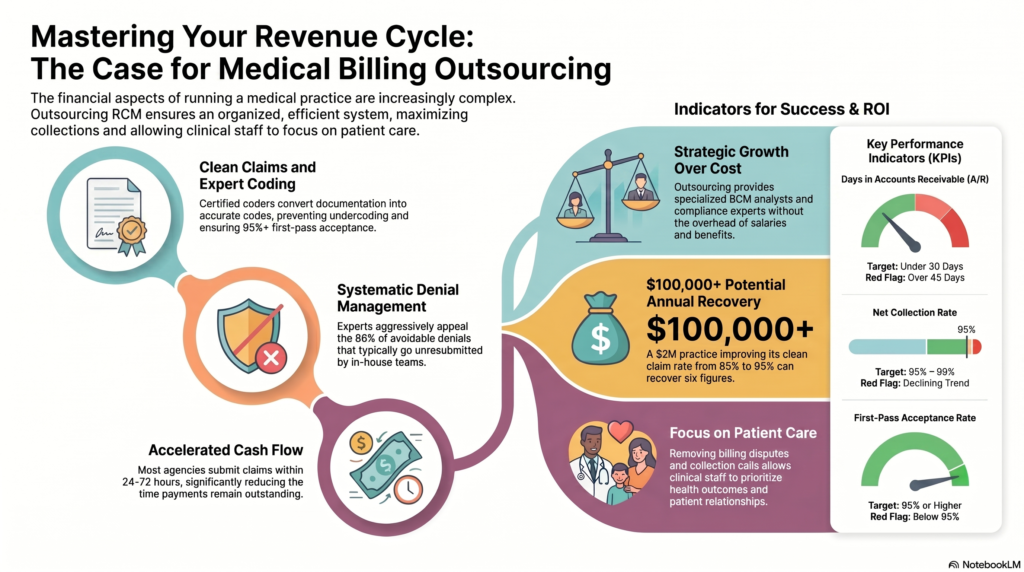
Patient care stands as the primary focus of every health care provider. As time goes on, the financial aspects of running a practice become more challenging. Denials of claims are increasing. Payer stipulations are in flux. Staff in billing departments are more burnt out than ever. Revenue is lost across multiple areas of the billing cycle and many practices remain unaware until it is too late.
The answer to the problem is to outsource medical billing. This solution is helping turn revenue cycle problems into an organized and efficient system generating revenue.
Partnering with a company that provides an outsourced medical billing solution allows you to utilize their certified medical coders, denial specialists, and revenue cycle analysts to improve your collection efforts. This solution should not be thought of as a cost saving option. It is truly a strategy for business growth.
This guide will provide everything you need to understand the medical billing outsourcing solution including the impact it can have on the efficiency of your RCM cycle and the criteria you can use to identify the most reputable medical billing outsourcing firms. It will also provide you the tools to determine the true cost benefit. This guide can be used by the owner of a small practice or a large multi-specialty practice with many locations.
What Is Medical Billing Outsourcing?
Outsourcing medical billing means hiring an external company to manage all aspects of medical billing, including coding, submitting claims, managing denials and collections, and medical billing related to coding and claims. Instead of having an in-house team and having to secure and maintain the software necessary to manage this part of the coding and billing process, you will work with a team of revenue cycle experts.
Outsourcing medical billing is a process and a service that has been available for many years, but has seen rapid growth in recent years. Market analysts have reported that the medical billing outsourcing market is over $11 billion, with forecasts predicting an increasing trend of market growth over 11% annually until 2030. Medical practitioners, from general practitioners to orthopedists and mental health practitioners, have realized that billing and coding is not a part of the medical practice and therefore should not be managed by the medical practice.
For most outsourced billing services, the following is managed by the service provider:
- Patient registration and insurance verification
- ICD-10, CPT and HCPCS medical coding
- Charge Entry and Claims Scrubbing
- Submission of Electronic Claims
- Payment Posting and Reconciliation
- Denial Management and Appeals
- Accounts Receivable Follow-Up
- Patient Billing and Collections
- Reporting and Analytics
The service offerings will vary by provider. Some billing service providers will offer minimal services, whereas others will be full-service Revenue Cycle Management partners.
Understanding the RCM Cycle in Medical Billing
Revenue Cycle Management (RCM) is an essential aspect of medical billing. It is also beneficial to know how the RCM cycle works in medical billing to understand how outsourcing medical billing can enhance the financial performance of a healthcare organization.
The RCM cycle in medical billing consists of many phases.
1. Pre-Authorization and Patient Registration
This phase occurs before a patient steps foot in the healthcare facility. It focuses on verifying insurance, patient authorizations, and patient demographics. If errors occur in this phase, they cause denial of payment in subsequent phases.
2. Medical Coding
In this phase, healthcare providers record notes pertaining to the diagnosis and procedure. This documentation is then converted into the pertinent codes for diagnosis and procedure by a medical coder. This phase is critical, as undercoding and overcoding have financial and compliance repercussions, respectively.
3. Charge Capture and Claims Submission
In this phase, coded claims are prepared and sent to healthcare payers. A crucial performance indicator is whether a claim is submitted without errors on the first attempt. A claim that is submitted without errors on the first attempt is termed a first-pass claim. If a healthcare practice has a first-pass claim acceptance rate of higher than 95%, the practice is likely to have a positive cash flow.
4. Payment Posting and Reconciliation
This phase involves posting payments as they are received. Payments are deemed to have been received if they are posted to patient claims. Any differences in the expected payment and the received payment are noted for further evaluation.
5. Denial Management
Once a claim is denied, it must be reviewed, corrected, and appealed by a specific time frame. Out of all the components of RCM in medical billing, denial management is the most resource-intensive. It is also the component that makes outsourcing medical billing the most beneficial.
6. Patient Collections
Once all insurance claims are processed, patient collection for the remaining balance begins. This has become increasingly important due to the prevalence of high-deductible health plans because the patient balance has become a larger percentage of the overall revenue for the medical practice.
7. Reporting and Analytics
The last part of revenue cycle management is measuring the performance of the medical practice. Lost revenue can be evaluated, and loss recovery can be maximized, by looking at performance measures such as average accounts receivable days and the net collection rate and measuring the number of clean claims.
Breakdowns in any part of this cycle will result in financial loss for the practice. This has led to more medical providers deciding to outsource medical billing to companies that are experts in ensuring that all components of the RCM cycle are completed effectively.
Top Reasons to Outsource Medical Billing Services
Outsourcing medical billing services is a significant operational decision for any health care practice. Here are some of the most important things to know about the reasons for this decision made by thousands of providers.
Diminish Claim Denials and Boost First-Pass Acceptance
Claim denials cause considerable revenue loss. It is said that 86% of claim denials are avoidable. However, 65% are never resubmitted, and those practices are losing revenue. Professional billing outsourcing agencies employ certified coders and denial experts who take measures to prevent denials, and when denials occur, they pursue appeals.
Speed Up Cash Flow
When claims are submitted accurately, payments are received sooner. Most outsourced medical billing agencies submit claims in 24 to 72 hours post the delivery of service. The improvement to the RCM cycle means days in accounts receivable is reduced and cash flow becomes more certain.
Utilize Specialized Knowledge Without Added Expense
Hiring, training, and attaining qualified billing staff is a loss of time and money. Outsourcing billing services means you get RCM specialists, coders, billers, denial specialists, and compliance experts, to name a few, without paying for their salaries, benefits, and continuing education. Medical billing outsourcing agencies are invested in the trade, so you are too.
Free Up Clinical Staff To Focus On Patient Care
In-house billing takes an enormous amount of physician and clinical staff time. When providers and their teams deal with billing disputes, prior authorization requests, and collection calls, their ability to see patients is severely impacted. Outsourcing medical billing gives practices time and energy to focus on what matters most, providing patient care.
Effortlessly Scale Billing Operations
Rapid growth and spikes in patient volume are challenges many practices face. Outsourcing medical billing solves this problem, as there are no hiring delays or training periods, and there is no staff turnover. Billing outsourcing services are scalable and provide a continuous service.
Enhance Compliance and Reduce Audit Risk
Compliance when it comes to healthcare billing is critical. Violations of HIPAA or OIG guidelines, along with a violation of payer policies, can result in financial consequences and harm to reputation. Medical billing outsourcing companies that reputation practice due diligence and have strict compliance policies and will conduct internal audits and stay up to date with regulatory changes.
Financial Insights
The leading companies that provide outsourced billing do not stop at submitting claims. They do analytics and provide reports that assess the financial standing of the practice. This provides insights into payer patterns and helps to identify trends of claim denials. This information allows practices to refine their revenue cycle management.
Indications You Should Choose an Outsourced Medical Billing Solution
How do you know when it’s time to make the switch? Here are the most telling indicators that your practice would benefit from choosing to outsource medical billing:
- Your clean claim rate is below 95%. Every claim rejected on first submission costs your practice time and money. If your first-pass acceptance rate is consistently below the industry benchmark, your billing process has a problem.
- Days in accounts receivable exceeds 45 days. The longer payments remain outstanding, the harder they are to collect. Optimal A/R is under 30 days. Exceeding 45 days is a red flag.
- More than 15% of your A/R is over 120 days old. Aged receivables are often uncollectible receivables. This is a significant signal that collections follow-up is not happening systematically.
- Your net collection rate is declining. If you are collecting less of what you are owed over time, it may indicate that denied claims are not being appealed, patient balances are going unpaid, or contract terms are outdated.
- High staff turnover in your billing department. Inconsistency in billing staffing leads to coding errors, missed deadlines, and compliance gaps. Each new hire requires weeks or months of training before they are fully productive.
- You are planning to expand your practice or add new providers. Growth means more complexity — new payer contracts, new specialties, higher claim volume. Scaling an in-house billing team is slow and costly. Outsourced medical billing grows with you instantly.
- Your team is overwhelmed and falling behind on follow-up. If accounts receivable follow-up and denial appeals are not happening consistently, revenue is being left uncollected.
If any of these scenarios describe your current situation, the case for medical billing outsourcing is compelling.
How Medical Billing Outsourcing Improves Revenue Cycle Management
The relationship between medical billing outsourcing and revenue cycle management is direct and powerful. Here is a breakdown of the specific ways outsource medical billing services enhance every stage of the RCM cycle.
Cleaner Claims, Faster Payments
Medical billing outsourcing companies use advanced claims scrubbing technology paired with certified coding expertise to submit cleaner claims. Fewer errors at submission mean fewer rejections, faster adjudication, and faster payments. A practice that improves its clean claim rate from 88% to 95% can recover hundreds of thousands of dollars in previously lost or delayed revenue.
Systematic Denial Prevention and Recovery
Experienced billing outsourcing services track denial patterns by payer, by code, and by provider. They identify root causes — whether it’s a documentation issue, a coding error, or a payer policy change — and address them systematically. They also maintain rigorous appeal timelines, ensuring that denied claims are resubmitted within payer deadlines.
Optimized Coding for Maximum Reimbursement
One of the most underappreciated benefits when you outsource medical billing is coding optimization. Certified Professional Coders (CPCs) review clinical documentation and ensure that every service performed is accurately and completely captured. This eliminates undercoding, which is one of the most common and most costly forms of revenue leakage.
Proactive Insurance Eligibility Verification
Many denials originate not in the billing department but at the front desk, where insurance information is collected inaccurately or eligibility is not verified before the appointment. Full-service outsource billing companies implement eligibility verification workflows that catch coverage issues before the patient is seen, preventing costly downstream denials.
Better Patient Collections
Revenue cycle management does not stop with insurance adjudication. As patient financial responsibility grows, practices need effective strategies for collecting copays, deductibles, and balances. Professional outsourced medical billing partners design patient-friendly billing statements, implement automated payment reminders, and offer flexible payment options that improve collection rates without damaging patient relationships.
Continuous Performance Monitoring
The best medical billing outsourcing companies deliver regular, detailed reports that track all critical revenue cycle management KPIs. This continuous monitoring allows practices to identify problems early, evaluate the impact of operational changes, and benchmark performance against industry standards.
Choosing the Right Medical Billing Outsourcing Companies
Not all medical billing outsourcing companies are equal. Choosing the wrong partner can actually make your revenue cycle problems worse, not better. Here is a framework for evaluating and selecting the right outsource billing services partner for your practice.
Define Your Practice’s Specific Needs
Before you begin evaluating vendors, be clear about what your practice requires. Consider:
- Your specialty and patient volume
- The complexity of your payer mix
- Whether you need full-service RCM or targeted support
- Your EHR system and data integration requirements
- Your timeline for transition
Look at Their Specialty Expertise
Billing will look different for those in behavioral health as opposed to orthopedics or billing cardiology. Medical billing outsourcing companies must have experience in your specialty. They should know the ins and outs of your payer contracts, the coding for your procedures, and the documentation requirements.
Evaluate Their Technology and How it Integrates
Your outsourcing billing team must be able to integrate with your EHR and the practice management system. Look for companies with billing software, real-time eligibility tools and reporting dashboards that give an overview of your RCM cycle.
Look at Their History and Their Clients
Ask the outsourcing billing services for performance metrics — clean claims, first-pass resolution, days in A/R and net collections. Also, get contact information of other similar sized and specialized practices that they have worked with. A good company will share this information.
Understand What Services They Offer
There are companies that will outsource billing and only take care of submitting claims. Others will do each step of the RCM process, from verifying eligibility to collecting payment. Make sure they are clear on what is included in the contract.
Check HIPAA Compliance and Security Protocols
Every partner of outsourced medical billing will need access to PHI. Ensure HIPAA Compliance is maintained, and Security Audits and Breach Procedures are documented. Do not skip this step.
Look at Communication and Reporting
Good medical billing outsourcing companies will genuinely partner with you and not just be a vendor. Good proactive communication and timely performance reporting are the hallmarks of true partnership. They should be readily available to discuss the financial health of your practice. Assess the level of responsiveness and transparency during the sales process as this will be an indicator of the level of partnership that you can expect.
Understand the Pricing Model
A percentage of collections, usually in the range of 4 to 8 percent, are how the majority of billing outsourcing services are compensated. Others may charge a flat monthly or per claim fee. Be sure you know and understand the pricing models prior to engaging with them.
What to Expect from Outsource Billing Services
Having an understanding of the typical processes of outsourced medical billing will help you to have a better understanding and appropriate expectations for the partner you are engaging with.
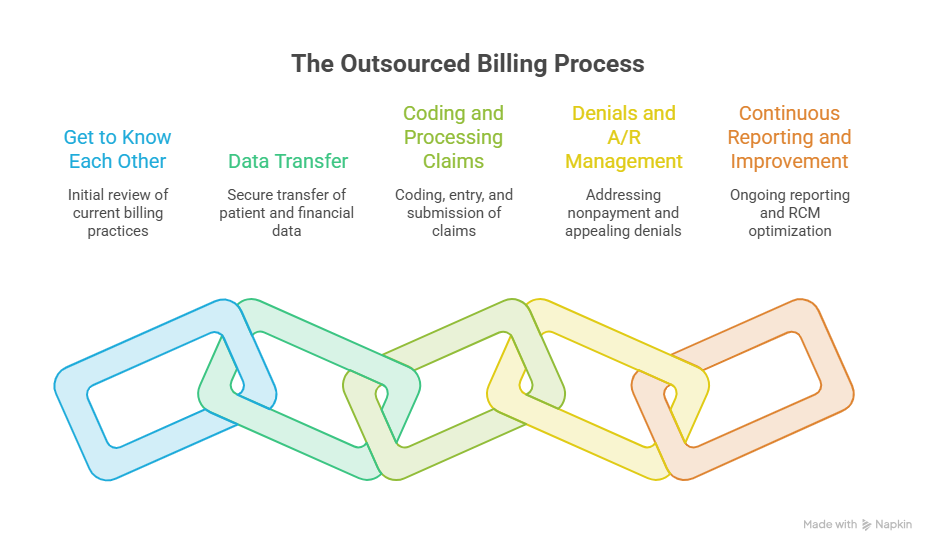
Step 1: Get to Know Each Other
The first step in the process is a high level review of your current billing, payers, denials, and software. Your partner in outsourced billing will create a custom plan for implementation to address what they have learned.
Phase 2: Data Transfer
Switching to outsourced medical billing demands the secure transfer of patient data, billing data, and financial data to the outsourcing partner through channels compliant with HIPAA. Reliable partners have encrypted transfer systems and implement trust standards.
Phase 3: Coding and Processing Claims
Your billing partner is responsible for all coding, charge entry, and submission of claims after the transition is completed. Their documentation will experience a learning curve and will require a stabilization period of 30 to 60 days.
Phase 4: Denials and A/R Management
Your partner will begin working on the submitted claims and the managing of accounts receivable to address the nonpayment of claims, appeal denials, and resolve aged receivables. This phase will have the greatest positive impact on your practice.
Phase 5: Continuous Reporting and Improvement
After a steady state for your practice is established, your billing partner will perform ongoing reporting for practice improvements and engage with your practice leadership for continuous RCM improvement.
Cost vs. Value: Medical Billing
Cost is a common concern for medical billing outsourcing, as the billing fees average between 4% and 8% of collections. However, when measuring the cost of the existing billing model and the revenue lost, the financial impact strongly supports medical billing outsourcing.
The Real Cost of In-House Billing
Managing billing in-house costs way more than most practices realize.
Tangible Costs
- Staff salaries, taxes, and office costs
- Staff health and retirement benefits
- Medical billing software
- Clearinghouse costs
- Mailing costs
- Costs for hardware
- Recruitment and training costs
Hidden Costs
- Funding the undercoding and lost charge revenue
- Funding the denial write-off revenue
- Funding the bad debt presented by patients
- Lost productivity and increased turnover
- Compliance risk
The Revenue Upside of Outsourcing
There is usually a large revenue impact when good partners are providing outsourced medical billing services. For example, a practice generating two million dollars in annual revenue with an 88% clean claim rate is writing off and waiting for collection of claims that total approximately $240,000 each year. If this practice were to partner with an outsourced medical billing company that offers a 95% clean claim rate, they could expect to recover $100,000 or more in write-off claims during that year alone.
For a practice generating $2 million in revenue, a small improvement in collections of 5% is an additional $100,000, which is a significant benefit to justify the investment in outsourced billing.
The ROI Formula
Here is a simple framework for calculating the ROI of medical billing outsourcing:
- Calculate your current annual net collection rate
- Estimate the improvement achievable with professional outsource billing services (industry benchmarks: 95-99% net collection rate)
- Multiply the improvement percentage by your annual gross charges
- Subtract the cost of billing outsourcing services (typically 4-8% of collections)
- Add the in-house billing costs you will no longer incur
In most cases, the net result is a significant increase in revenue and a reduction in total billing costs.
Key Metrics to Track After You Outsource Billing Services
Once you have made the decision to outsource medical billing, ongoing performance monitoring is essential to ensure you are getting full value from the partnership. Here are the key metrics every practice should track:
First-Pass Acceptance Rate (FPAR)
Target: 95% or higher
This is the percentage of claims accepted by the payer on first submission. A high FPAR indicates accurate coding, complete claim information, and effective eligibility verification. This metric is foundational to a healthy RCM cycle in medical billing.
Formula: (Total claims submitted − Rejected claims) ÷ Total claims submitted × 100
Days in Accounts Receivable (A/R)
Target: Fewer than 30 days
Days in A/R measures how long it takes to collect payment after services are rendered. Reducing days in A/R improves cash flow and reduces the risk of uncollectible balances. Your outsource medical billing partner should be actively working to keep this metric as low as possible.
Formula: Total outstanding A/R ÷ Average daily charges
Net Collection Rate
Target: 95% to 99%
Net collection rate measures the percentage of collectible revenue that is actually collected after contractual adjustments. This is arguably the most important performance indicator for revenue cycle management.
Formula: Total payments collected ÷ (Total charges − Contractual adjustments) × 100
Denial Rate
Target: Below 5%
The denial rate tracks the percentage of submitted claims that are denied by payers. A rising denial rate indicates problems with coding accuracy, documentation, eligibility verification, or payer contract management. Best-in-class medical billing outsourcing companies consistently achieve denial rates below 5%.
Percentage of A/R Over 120 Days
Target: Below 10%
Receivables that are more than 120 days old are at serious risk of becoming uncollectible. Monitoring this metric helps identify whether your outsource billing services partner is actively pursuing aged accounts or allowing them to stagnate.
Clean Claim Rate
Target: 95% or higher
The clean claim rate measures the percentage of claims submitted without errors that require correction or additional information. A high clean claim rate is a direct indicator of coding quality and the effectiveness of your billing outsourcing services partner’s pre-submission review process.
Common Mistakes to Avoid When Choosing Outsource Billing Companies
Even with the best intentions, some practices make avoidable mistakes when transitioning to outsourced medical billing. Here are the most common pitfalls — and how to avoid them.
Choosing on Price Alone
The cheapest outsource billing companies are rarely the best. A low fee means little if the company achieves poor collection rates, submits unclean claims, or fails to appeal denials aggressively. Evaluate medical billing outsourcing companies on their performance metrics, not just their price.
Not Verifying Specialty Experience
A billing company that excels in primary care may struggle with cardiology or behavioral health. Always confirm that your billing outsourcing services partner has relevant experience in your specific specialty and understands your payer mix.
Neglecting HIPAA and Compliance Verification
Never work with an outsource medical billing company that cannot provide detailed documentation of its HIPAA compliance program, data security protocols, and employee training practices. The liability for a data breach or compliance violation ultimately rests with your practice.
Failing to Establish Clear KPIs and Reporting Requirements
Before signing a contract with any outsource billing services company, define the performance metrics you expect them to meet and the reporting cadence and format you require. Hold your partner accountable to these benchmarks from day one.
Not Asking Who Owns Your Data
This is a critical question that many practices overlook. Confirm from the outset that your practice retains full ownership of all billing data and that the data is fully portable if you decide to change outsource billing companies in the future.
Expecting Instant Results
Transitioning to medical billing outsourcing is a process, not a switch. Allow 60 to 90 days for your new partner to stabilize operations, learn your documentation patterns, and begin delivering consistent performance improvements.
How CareVanta RCM Elevates Medical Billing Outsourcing
At CareVanta RCM, we understand that choosing to outsource medical billing is a major decision — one that directly impacts your practice’s financial health and operational stability. That is why we have built our medical billing outsourcing services around a commitment to transparency, performance, and partnership.
Our team of certified coders, denial management specialists, and revenue cycle management experts brings decades of combined experience across multiple specialties. We do not just submit claims — we manage your entire RCM cycle in medical billing from pre-authorization through final collections.
When you partner with CareVanta RCM for billing outsourcing services, you can expect:
- Industry-leading clean claim rates consistently at or above 95%
- Average days in A/R below 30 days through proactive follow-up and systematic denial management
- Dedicated account managers who know your practice and communicate proactively
- Real-time reporting dashboards that give you full visibility into your revenue cycle management performance
- Full HIPAA compliance and rigorous data security protocols
- Specialty-specific expertise tailored to your practice’s unique billing requirements
- Scalable solutions that grow with your practice
We believe that outsource medical billing partnerships should be collaborative, transparent, and built on measurable results. Our clients don’t just see improvements in their numbers — they experience a transformation in how their practices operate and how their teams feel about their work.
Whether you are a solo practitioner looking for your first billing outsourcing services partner or a multi-site group ready to upgrade from a sub-par vendor, CareVanta RCM has the expertise, technology, and commitment to deliver exceptional outsourced medical billing results.
Final Words
The decision to outsource medical billing is one of the most impactful choices a healthcare practice can make. In an environment where payer complexity is increasing, denial rates are rising, and the cost of maintaining skilled in-house billing staff continues to climb, medical billing outsourcing offers a powerful solution that improves financial performance, reduces operational burden, and allows providers to focus on what they do best — caring for patients.
By partnering with experienced medical billing outsourcing companies, you gain access to certified coding expertise, advanced denial management capabilities, and a systematic approach to revenue cycle management that most in-house teams simply cannot match. You reduce days in accounts receivable, improve clean claim rates, recover more denied revenue, and ultimately collect more of what you have earned.
Whether you choose to outsource billing services for the first time or are looking to upgrade from an underperforming partner, the key is to select a company that aligns with your specialty, your values, and your performance expectations. Define your KPIs clearly, demand transparent reporting, and hold your billing outsourcing services partner accountable to measurable results.
At CareVanta RCM, we are committed to being that partner. Our outsourced medical billing solutions are designed to optimize every stage of your RCM cycle in medical billing, from the first patient interaction to the final payment collected. We measure our success by your financial outcomes — and we have the track record to back it up.
Ready to transform your revenue cycle? Contact CareVanta RCM today to learn how our medical billing outsourcing services can help your practice achieve the financial performance it deserves.
FAQs: Medical Billing Outsourcing Services
What is medical billing outsourcing?
Medical billing outsourcing is the process of delegating your practice’s billing, coding, claims submission, denial management, and collections functions to a specialized external company. When you outsource medical billing, a team of dedicated RCM professionals handles these functions on your behalf, allowing your clinical team to focus on patient care.
How much do medical billing outsourcing companies charge?
Most medical billing outsourcing companies charge a percentage of collections, typically ranging from 4% to 8%. The exact rate depends on your specialty, claim volume, and the scope of billing outsourcing services you require. Some outsource billing companies also offer flat monthly fees or hybrid pricing models.
What is the RCM cycle in medical billing?
The RCM cycle in medical billing refers to the complete financial process that healthcare providers use to manage patient billing from initial registration through final payment collection. It includes pre-authorization, eligibility verification, medical coding, claims submission, payment posting, denial management, patient collections, and performance reporting. Effective revenue cycle management maximizes reimbursements and minimizes revenue leakage.
How does outsourcing medical billing improve revenue cycle management?
When you outsource medical billing services to a specialized partner, you gain access to certified coders, denial specialists, and RCM experts who focus exclusively on maximizing your collections. They submit cleaner claims, manage denials more aggressively, collect payments faster, and provide analytics that help you continuously improve your RCM cycle in medical billing.
What should I look for in outsource billing services?
When evaluating outsource billing services, look for specialty-specific experience, strong performance metrics (clean claim rate, days in A/R, net collection rate), advanced technology and EHR integration, full HIPAA compliance, transparent reporting, and a proven track record. Ask for references from practices similar in size and specialty to yours.
How long does it take to see results from outsourced medical billing?
Most practices see initial improvements in their revenue cycle management within the first 60 to 90 days of transitioning to outsourced medical billing. Full performance optimization typically takes three to six months as your partner refines workflows, addresses denial root causes, and implements best practices specific to your payer mix.
Is it safe to outsource medical billing from a HIPAA perspective?
Yes — provided you select a reputable medical billing outsourcing company that maintains a comprehensive HIPAA compliance program, uses encrypted data transmission, conducts regular security audits, and trains its staff on data privacy requirements. Always request detailed documentation of a vendor’s security protocols before signing a contract.
Can I outsource medical billing if I have a small practice?
Absolutely. Medical billing outsourcing services are available for practices of all sizes, from solo providers to large multi-specialty groups. In fact, small practices often benefit the most from outsourced medical billing because they lack the resources to hire and train dedicated billing staff, making external expertise especially valuable.
What happens to my current billing staff if I outsource billing services?
This is an important consideration. Some practices redeploy billing staff into other roles — such as patient financial counseling, front desk coordination, or administrative functions — while others reduce headcount as part of the transition. Plan this carefully and communicate transparently with your team to manage the transition smoothly.
How do I measure the success of my medical billing outsourcing partnership?
Track key revenue cycle management metrics including first-pass acceptance rate, days in accounts receivable, net collection rate, denial rate, clean claim rate, and percentage of A/R over 120 days. Compare these metrics to industry benchmarks and to your pre-outsourcing performance. A high-performing billing outsourcing services partner will provide regular reports on all of these indicators.