

CareVantaRCM

Optimize Revenue. Reduce Denials. Strengthen Practice Growth.

Medical billing outsourcing

outsource medical billing
Medical billing outsourcing

Outsource Medical Billing to Improve RCM Cycle

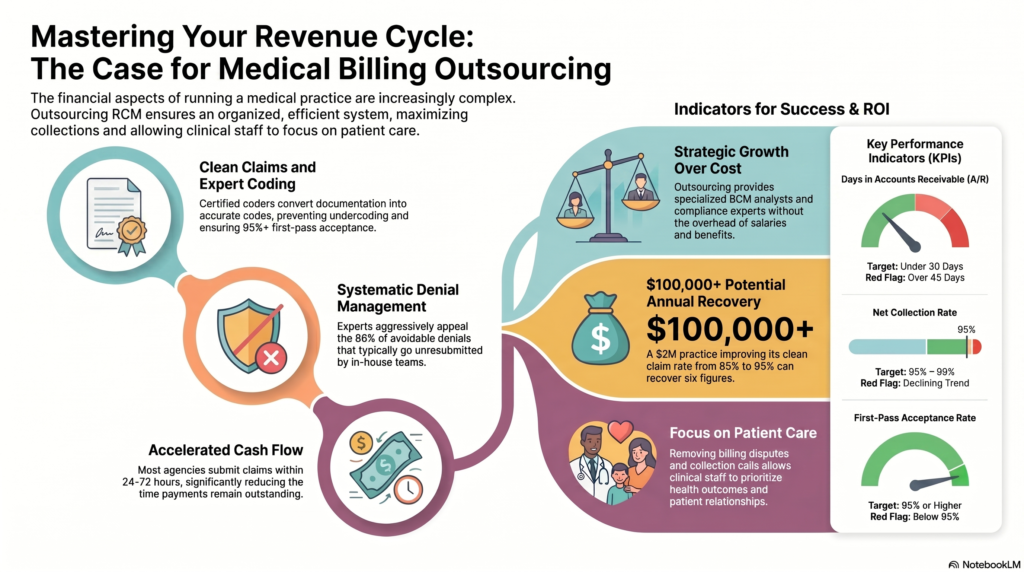
Introduction Patient care stands as the primary focus of every health care provider. As time goes on, the financial aspects of running a practice become more challenging. Denials of claims are increasing. Payer stipulations are in flux. Staff in billing departments are more burnt out than ever. Revenue is lost across multiple areas of the billing cycle and many practices remain unaware until it is too late. The answer to the problem is to outsource medical billing. This solution is helping turn revenue cycle problems into an organized and efficient system generating revenue. Partnering with a company that provides an outsourced medical billing solution allows you to utilize their certified medical coders, denial specialists, and revenue cycle analysts to improve your collection efforts. This solution should not be thought of as a cost saving option. It is truly a strategy for business growth. This guide will provide everything you need to understand the medical billing outsourcing solution including the impact it can have on the efficiency of your RCM cycle and the criteria you can use to identify the most reputable medical billing outsourcing firms. It will also provide you the tools to determine the true cost benefit. This guide can be used by the owner of a small practice or a large multi-specialty practice with many locations. What Is Medical Billing Outsourcing? Outsourcing medical billing means hiring an external company to manage all aspects of medical billing, including coding, submitting claims, managing denials and collections, and medical billing related to coding and claims. Instead of having an in-house team and having to secure and maintain the software necessary to manage this part of the coding and billing process, you will work with a team of revenue cycle experts. Outsourcing medical billing is a process and a service that has been available for many years, but has seen rapid growth in recent years. Market analysts have reported that the medical billing outsourcing market is over $11 billion, with forecasts predicting an increasing trend of market growth over 11% annually until 2030. Medical practitioners, from general practitioners to orthopedists and mental health practitioners, have realized that billing and coding is not a part of the medical practice and therefore should not be managed by the medical practice. For most outsourced billing services, the following is managed by the service provider: The service offerings will vary by provider. Some billing service providers will offer minimal services, whereas others will be full-service Revenue Cycle Management partners. Understanding the RCM Cycle in Medical Billing Revenue Cycle Management (RCM) is an essential aspect of medical billing. It is also beneficial to know how the RCM cycle works in medical billing to understand how outsourcing medical billing can enhance the financial performance of a healthcare organization. The RCM cycle in medical billing consists of many phases. 1. Pre-Authorization and Patient Registration This phase occurs before a patient steps foot in the healthcare facility. It focuses on verifying insurance, patient authorizations, and patient demographics. If errors occur in this phase, they cause denial of payment in subsequent phases. 2. Medical Coding In this phase, healthcare providers record notes pertaining to the diagnosis and procedure. This documentation is then converted into the pertinent codes for diagnosis and procedure by a medical coder. This phase is critical, as undercoding and overcoding have financial and compliance repercussions, respectively. 3. Charge Capture and Claims Submission In this phase, coded claims are prepared and sent to healthcare payers. A crucial performance indicator is whether a claim is submitted without errors on the first attempt. A claim that is submitted without errors on the first attempt is termed a first-pass claim. If a healthcare practice has a first-pass claim acceptance rate of higher than 95%, the practice is likely to have a positive cash flow. 4. Payment Posting and Reconciliation This phase involves posting payments as they are received. Payments are deemed to have been received if they are posted to patient claims. Any differences in the expected payment and the received payment are noted for further evaluation. 5. Denial Management Once a claim is denied, it must be reviewed, corrected, and appealed by a specific time frame. Out of all the components of RCM in medical billing, denial management is the most resource-intensive. It is also the component that makes outsourcing medical billing the most beneficial. 6. Patient Collections Once all insurance claims are processed, patient collection for the remaining balance begins. This has become increasingly important due to the prevalence of high-deductible health plans because the patient balance has become a larger percentage of the overall revenue for the medical practice. 7. Reporting and Analytics The last part of revenue cycle management is measuring the performance of the medical practice. Lost revenue can be evaluated, and loss recovery can be maximized, by looking at performance measures such as average accounts receivable days and the net collection rate and measuring the number of clean claims. Breakdowns in any part of this cycle will result in financial loss for the practice. This has led to more medical providers deciding to outsource medical billing to companies that are experts in ensuring that all components of the RCM cycle are completed effectively. Top Reasons to Outsource Medical Billing Services Outsourcing medical billing services is a significant operational decision for any health care practice. Here are some of the most important things to know about the reasons for this decision made by thousands of providers. Diminish Claim Denials and Boost First-Pass Acceptance Claim denials cause considerable revenue loss. It is said that 86% of claim denials are avoidable. However, 65% are never resubmitted, and those practices are losing revenue. Professional billing outsourcing agencies employ certified coders and denial experts who take measures to prevent denials, and when denials occur, they pursue appeals. Speed Up Cash Flow When claims are submitted accurately, payments are received sooner. Most outsourced medical billing agencies submit claims in 24 to 72 hours post the delivery of service. The improvement to
medical billing outsourcing
Medical billing outsourcing

Outsource Medical Billing Services: Key Benefits for Healthcare Practices

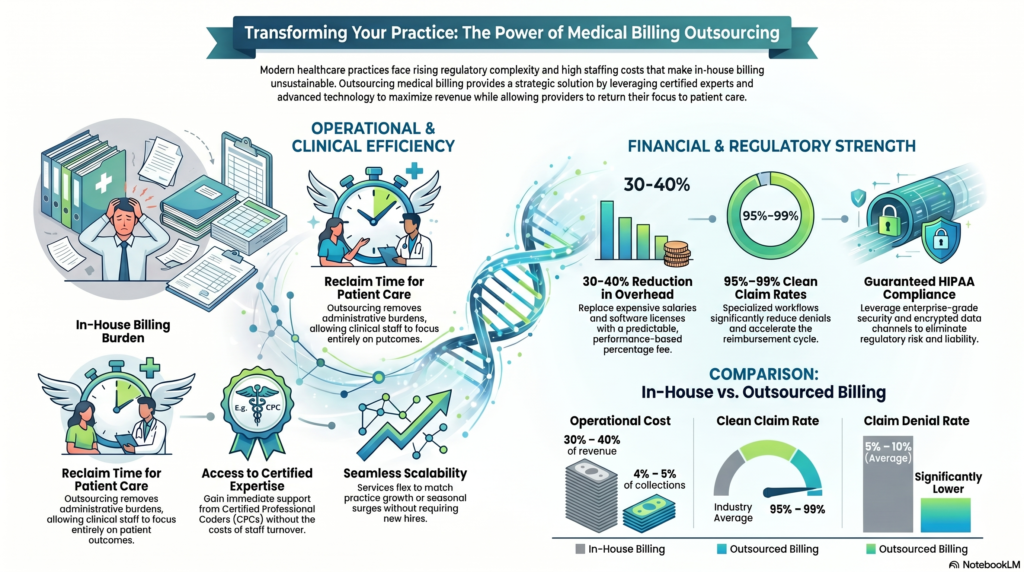
Introduction Running a healthcare practice today is more demanding than ever. Between delivering quality patient care, navigating ever-changing insurance regulations, and managing administrative operations, physicians and practice managers are stretched in multiple directions. One area that consistently drains time, money, and energy is medical billing. Medical billing outsourcing has emerged as one of the most powerful strategies for healthcare providers looking to streamline operations, increase revenue, and cut unnecessary costs. When you outsource medical billing services to a dedicated team of certified professionals, your practice gains access to specialized expertise, cutting-edge billing software, and a proven process designed to maximize reimbursements. This comprehensive guide explores everything you need to know about outsourcing medical billing — from the core benefits and how to select the right billing outsourcing services, to what the process looks like in practice and how it transforms your revenue cycle. Whether you are a solo practitioner or manage a multi-specialty group, understanding medical billing outsourcing can be the turning point that drives lasting financial and operational improvement. What Is Medical Billing Outsourcing? Medical billing outsourcing is the practice of hiring a third-party company or specialized service provider to handle all or part of your revenue cycle management (RCM) on your behalf. Rather than maintaining an in-house billing department, healthcare providers delegate billing responsibilities — including charge capture, claim submission, denial management, payment posting, and accounts receivable follow-up — to experienced outsource billing companies. These billing outsourcing services operate as an extension of your practice. They work closely with your clinical and administrative staff, integrate with your existing Electronic Health Record (EHR) systems, and follow strict protocols to ensure that every claim is submitted accurately and reimbursed promptly. Medical billing outsourcing companies range from large national RCM firms serving hospital systems to specialized boutique agencies that focus exclusively on specific medical specialties. Regardless of size, the best outsource billing companies share a commitment to coding accuracy, compliance, and performance-driven results. Outsourcing is not a one-size-fits-all solution, but it is a model that consistently delivers measurable improvements in clean claim rates, denial rates, days in accounts receivable, and net collection rates — making it an increasingly popular choice for practices of all sizes. The Growing Demand for Outsource Medical Billing Services The U.S. healthcare industry is undergoing rapid transformation. Regulatory complexity, the shift toward value-based care, evolving payer requirements, and staffing shortages have made in-house billing increasingly difficult to sustain at a high level. Billing errors cost the healthcare industry billions of dollars every year. Studies show that claim denial rates average between 5% and 10% across healthcare organizations, with some specialties experiencing even higher rates. Denied and delayed claims reduce cash flow, consume staff time, and, in worst-case scenarios, lead to revenue that is never recovered. Additionally, the ongoing challenge of finding, training, and retaining skilled billing staff has pushed more practices to consider outsourcing medical billing as a strategic alternative. High staff turnover in billing departments disrupts workflows, increases errors, and adds significant hidden costs in the form of recruitment and retraining expenses. These pressures have fueled strong growth in the medical billing outsourcing market. More practices, hospitals, and healthcare groups are recognizing that partnering with specialized outsource billing services offers a measurably better outcome than trying to manage this complex function internally — especially when core competencies lie in clinical care rather than billing administration. Key Benefits of Outsourcing Medical Billing Understanding the specific advantages is crucial before making any outsourcing decision. Here are the ten most impactful benefits of outsourcing medical billing that practices report after making the switch. 1. Significant Cost Reduction One of the most compelling benefits of outsourcing medical billing is the dramatic reduction in operational costs. Maintaining an in-house billing team involves salaries, benefits, paid time off, health insurance, ongoing training, billing software licenses, hardware, and office space. These costs add up quickly — often totaling 30% to 40% of total billing revenue for smaller practices. When you outsource billing services, you replace this complex cost structure with a predictable, performance-based fee — typically a percentage of collections (usually 4%–9%) or a flat monthly rate. This shift eliminates the overhead of managing employees entirely and ensures you only pay for results. The savings extend beyond payroll. Medical billing outsourcing companies invest in their own state-of-the-art billing platforms, clearinghouses, and compliance monitoring tools. You benefit from enterprise-grade infrastructure without incurring the capital expense to acquire it. For small and mid-sized practices in particular, this cost efficiency is transformational. Resources that were previously consumed by billing operations can be redirected toward patient care, equipment upgrades, or practice expansion. 2. Improved Revenue Cycle Management Revenue cycle management (RCM) is the financial backbone of any healthcare practice. It encompasses every step from patient registration and insurance verification through charge capture, coding, claim submission, payment posting, and collections. When any part of this cycle breaks down, revenue suffers. Medical billing outsourcing companies are specialists in RCM. Their teams understand every phase of the revenue cycle and apply proven, optimized workflows to accelerate cash flow and reduce revenue leakage. They conduct eligibility verifications before appointments, flag potential coding issues before claims are submitted, and aggressively follow up on outstanding balances. The result is a healthier revenue cycle with shorter accounts receivable (A/R) cycles, higher collection rates, and fewer write-offs. Practices that outsource medical billing services typically see a measurable improvement in their net collection rate — often moving from below-average collection rates to industry-leading performance within the first few months. 3. Fewer Claim Denials and Faster Reimbursements Claim denials are one of the biggest threats to a practice’s financial health. Each denied claim requires staff time to identify the reason, correct the error, and resubmit — a process that can take weeks. In many cases, denials that are not addressed promptly result in permanent revenue loss. Outsourcing medical billing significantly reduces denial rates by deploying certified medical coders and billing specialists who are trained to get claims right the first time. Medical billing outsourcing companies maintain

Scroll to Top