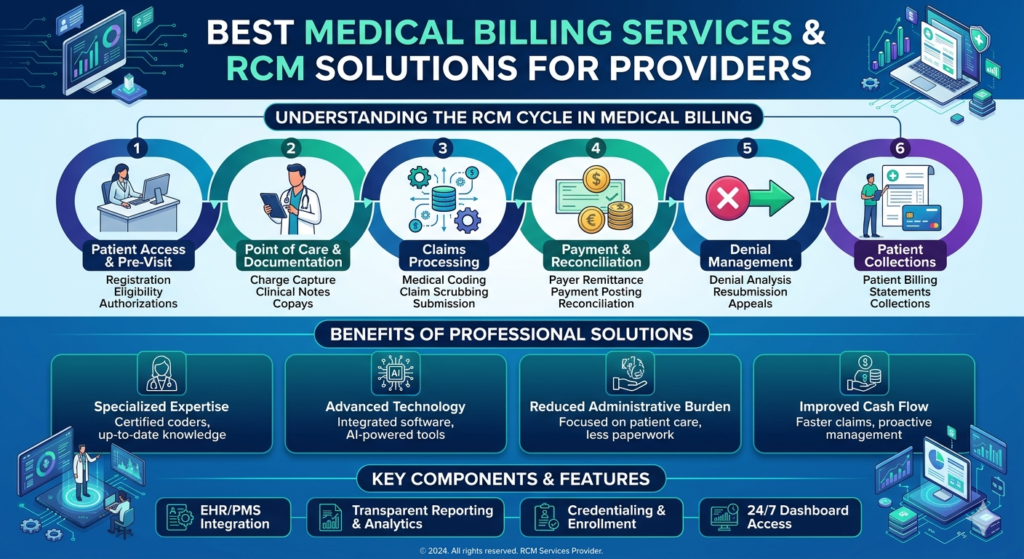

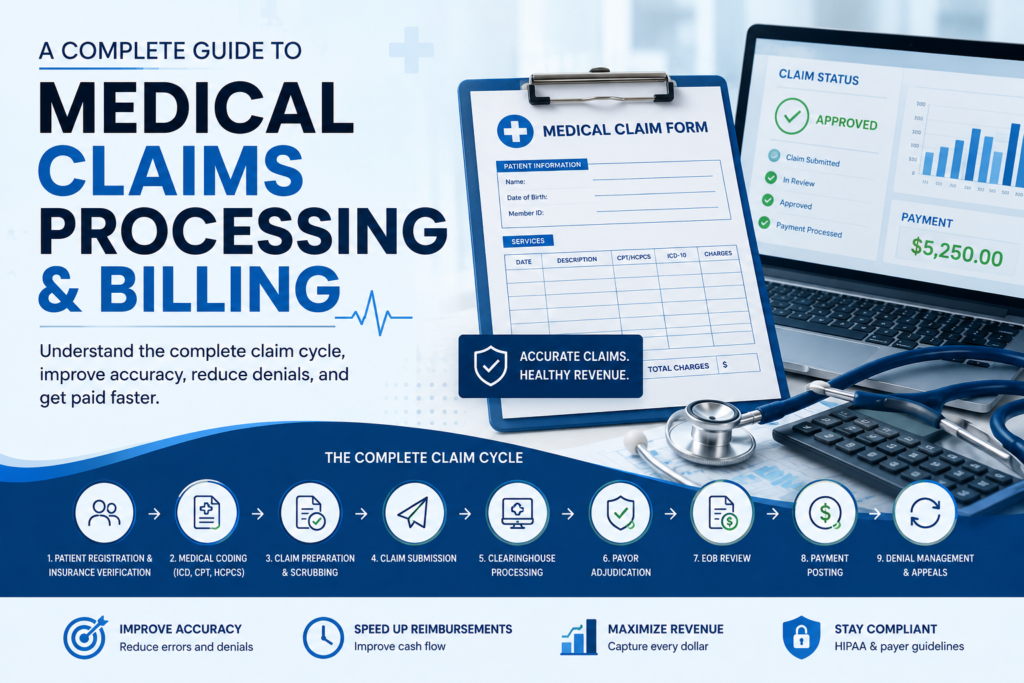
What is Medical Claims Processing and Billing? A Complete Guide
Introduction Medical claims processing is the backbone of every healthcare practice’s revenue cycle. Without a clean, efficient medical claims processing workflow, even the most successful provider will struggle with delayed reimbursements, denied claims, and mounting administrative burdens. Whether you run a solo practice or a large multi-specialty clinic, understanding how healthcare claims processing works — from the moment a patient walks in to the moment payment lands in your account — is essential for financial sustainability. This guide breaks down every stage of the medical billing claims process in plain language. You will learn what medical claims processing involves, how the claim cycle in medical billing flows, what claims management solutions exist, and why many providers are turning to outsourced medical claims management to protect their revenue. By the end, you will have a clear picture of what it takes to get claims paid accurately and on time. What Is Medical Claims Processing? Medical claims processing is the system where health care providers send requests to payers to receive payment for a service provided to a patient. After examining the claim, the payer will process the request, and if there are no issues, they will send payment. If there is a problem with the claim, the payer will send a reason code explaining why payment will not be made. The medical billing claims process involves far more than simply sending an invoice. It requires precise documentation, strict adherence to coding standards, compliance with HIPAA regulations, and an in-depth understanding of each Payor’s individual rules and fee schedules. A single coding error or missing piece of patient information can cause a claim to be denied — delaying cash flow and triggering a costly appeal process. In short, medical claims processing sits at the intersection of clinical care and financial operations. Getting it right requires both medical knowledge and administrative expertise. The Full Claim Cycle in Medical Billing Understanding the complete claim cycle in medical billing is essential before diving into individual steps. The cycle begins at patient registration and ends only when the final payment is posted. Here is how each phase connects: Each stage of this claim cycle in medical billing depends on the accuracy of the previous one. A mistake at step two — wrong CPT code — will create a cascade of problems all the way through to step nine. This interdependency is exactly why healthcare claims processing requires skilled professionals at every touchpoint. Step 1 — Patient Registration and Insurance Verification The workflow of medical claims processing begins before the patient receives any service. It starts with the registration process for the patient when the staff at the front desk collects and verifies necessary patient information. Insurance verification confirms that the patient’s policy is active, that the provider is in-network, and that the intended services are covered. Skipping this step is one of the leading causes of claim denials. Robust claims management solutions automate eligibility verification to reduce manual errors and speed up the entire healthcare claims processing pipeline. Step 2 — Medical Coding: ICD, CPT, and HCPCS Medical coding is the technical heart of the medical billing claims process. Every diagnosis, procedure, and service must be translated into universally recognized alphanumeric codes before claims can be submitted to insurers. ICD Codes (International Classification of Diseases): These codes describe the patient’s diagnosis. The current version, ICD-10-CM, contains more than 70,000 codes covering every clinical condition. Selecting the most specific, accurate ICD code is critical for medical claims processing because Payors use diagnosis codes to determine medical necessity. CPT Codes (Current Procedural Terminology): These codes describe the services and procedures performed. Maintained by the American Medical Association (AMA), CPT codes tell the Payor exactly what treatment was delivered. HCPCS Codes (Healthcare Common Procedure Coding System): Used primarily for Medicare and Medicaid claims, HCPCS Level II codes cover equipment, supplies, and non-physician services not listed in the CPT set. Correct coding is non-negotiable in medical claims management. Upcoding (billing for a higher level of service than provided) constitutes fraud, while downcoding (underreporting services) leads to revenue loss. Certified coders with current training in healthcare claims processing systems are indispensable for this step. Step 3 — Claim Preparation and Scrubbing Once coding is complete, the billing team prepares the claim for submission. A complete medical claim must include: Before the claim leaves the practice, it should be “scrubbed” — checked for errors, missing fields, and formatting inconsistencies. Claims management solutions with built-in scrubbing engines can flag issues automatically, saving valuable time and preventing costly rejections at the Payor level. Step 4 — Claim Submission in Medical Billing Claim submission in medical billing is the point at which the prepared claim is sent to the Payor. Today, the vast majority of healthcare claims are submitted electronically through HIPAA-compliant EDI (Electronic Data Interchange) formats — most commonly the 837P (professional) or 837I (institutional) transaction sets. Electronic claim submission in medical billing offers several advantages over paper claims: Some providers still submit paper claims (CMS-1500 for professional services, UB-04 for facilities), but electronic submission is considered best practice in modern healthcare claims processing systems. The timeliness of claim submission also matters — most Payors enforce filing deadlines ranging from 90 days to one year from the date of service. Missing these windows can result in a non-payable denial. Step 5 — The Role of Clearinghouses in Healthcare Claims Processing Between the provider and the Payor sits a critical intermediary: the clearinghouse. Clearinghouses are third-party organizations that act as quality checkpoints in the healthcare claims processing pipeline. When a claim arrives at the clearinghouse, it undergoes: If the clearinghouse identifies errors, it returns the claim to the provider as a rejected claim (not the same as a denial). Rejected claims have not been seen by the Payor yet, so they can be corrected and resubmitted quickly without triggering a formal denial. Advanced claims management solutions integrate directly with clearinghouses, providing real-time visibility into claim status and rejection rates. This integration is a key